

Tool Interface Preview
Random Phone Number Batch Generator
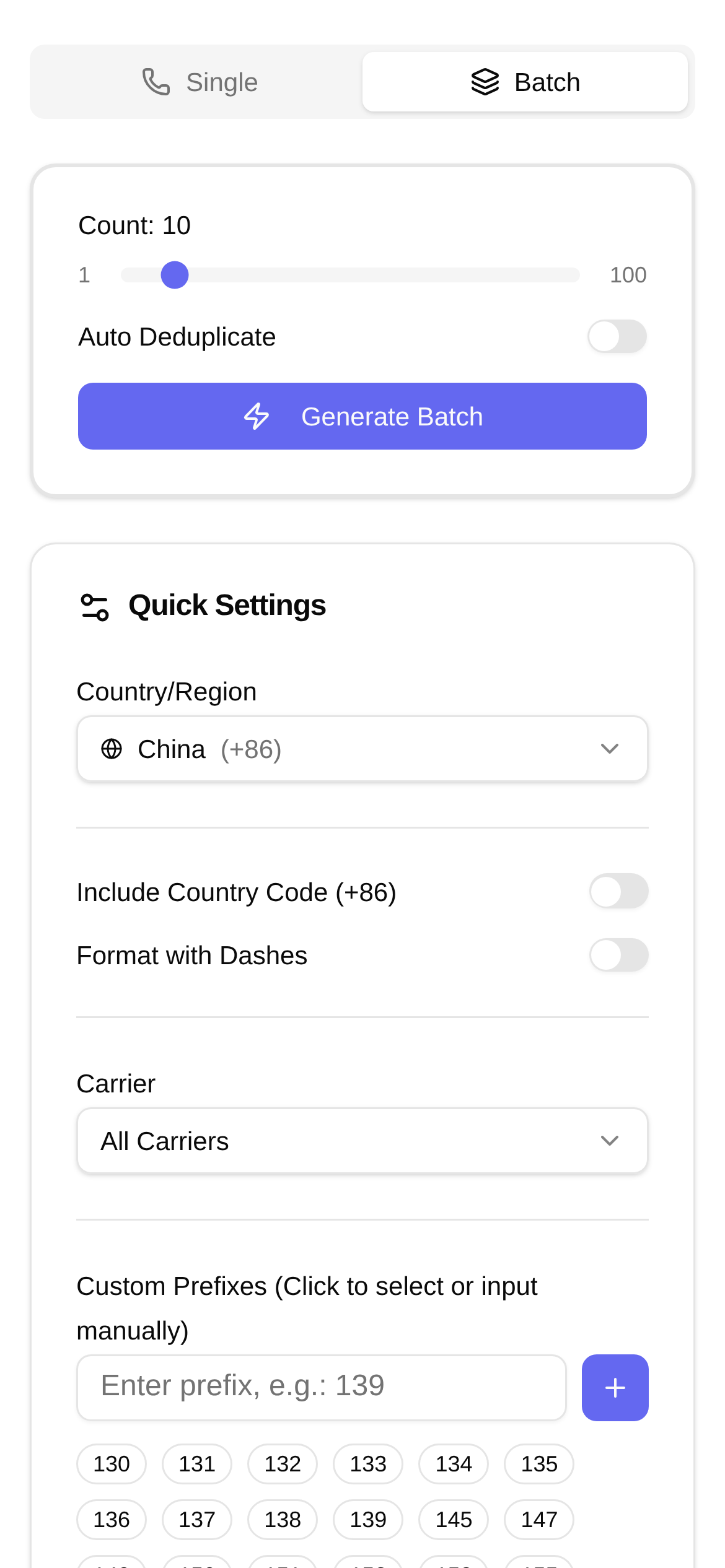
In software development, the quality of test data is like the foundation of a house—it directly determines the reliability of our testing results. However, manually constructing test data piece by piece is incredibly time-consuming and labor-intensive. It's easy to lose sight of the big picture, and those bizarre edge cases can easily slip through the cracks. On the other hand, if we directly use data from the production environment, we immediately face the hurdle of privacy compliance.
So, is there a best-of-both-worlds solution to generate test data quickly and effectively, skyrocketing our software testing efficiency? Don't worry, today I'm going to share some of my practical experience with you.
Test Data: Just Being Random Isn't Enough!
Generating "decent" test data isn't just about filling in random text. There's a lot of science behind it. You have to consider data types, data distribution, logical correlations between data points, and the appropriate volume to generate. In my opinion, a reliable test data generation solution needs to have at least the following capabilities:
- Handles all data types: It shouldn't just generate basic types like strings, numbers, dates, and booleans, but also easily handle complex structures like JSON and XML.
- Customizable data distribution: You should be able to define the probability of data occurrence, such as normal, uniform, or exponential distribution, making the generated data closer to real-world scenarios.
- Logical correlations: Data across different fields must make sense together. For example, a person's age must match their date of birth; the total order amount must equal the unit price multiplied by the quantity. These correlations cannot be lost.
- Fast batch generation: We often need massive amounts of data for performance and stress testing, so slow generation speeds are unacceptable.
- Strict privacy protection: For sensitive information like phone numbers, ID numbers, and names, it must generate data with the correct format but random content to prevent real data leaks.
Does Your Project Need It Too?
Honestly, a high-quality test data generation solution can be used throughout almost every stage of software development. Its applications are incredibly broad:
- Unit and Integration Testing: Feeding controlled inputs to individual modules or APIs to verify their functionality.
- System and End-to-End Testing: Simulating user operations from start to finish to run through the entire business process and check for issues.
- Performance and Stress Testing: Throwing massive amounts of data at the system to see if it can handle high concurrency and large data volumes.
- API Integration: During decoupled frontend and backend development, the frontend can use mock data to develop and debug even if the backend APIs aren't ready yet, keeping both teams unblocked.
- Data Desensitization and Privacy: Want to use data structures similar to production in the test environment without exposing real information? Generating properly formatted random data is the best choice.
For example, in business flows like user registration, login, and order processing, we often need a large number of phone numbers for testing. Typing them out manually one by one is painfully slow and highly error-prone. This is where a tool like the "Random Phone Number Batch Generator" comes in handy. It can instantly generate a large batch of random numbers that comply with Chinese phone number formats based on your requirements, instantly boosting your testing efficiency.
Step-by-Step Guide: Using the Phone Number Generator as an Example
To make things clearer, let's walk through a practical example using one of the most common needs: generating random phone numbers for testing. Here, I recommend a highly intuitive online tool that I frequently use: the Random Phone Number Batch Generator.
1. Open the Tool Page:
Simply click the link above or manually enter the URL https://www.toolkk.com/tools/random-phone-number-batch-generator to access it.
2. Enter the Generation Quantity:
Find the input box labeled "Generation Quantity" on the page and enter the number of phone numbers you need, such as "1000".
3. Customize the Prefix (Optional):
If you want the generated phone numbers to belong to a specific carrier or region, you can fill in the "Custom Prefix" field. For example, entering "138" will generate phone numbers starting with 138. This feature is quite practical for simulating specific user groups or testing business logic related to phone number prefixes.
4. Click "Generate":
Double-check your settings, then click the "Generate" button. The tool will instantly list a large batch of random phone numbers for you.
5. Export and Use:
The generated results are usually displayed directly on the page for you to copy. If the volume is large, you can also choose to export them as a CSV or TXT file, making it easy to import them into your database or test scripts.
How about that? The "Random Phone Number Batch Generator" is incredibly easy to use. Even beginners new to testing can get the hang of it quickly and never have to worry about manually typing phone numbers again. For developers and QA engineers who need massive amounts of phone numbers to test registrations, SMS verification codes, or call center features, this tool is an absolute lifesaver.
FAQs and Quick Tips
Q1: Is the generated test data actually "realistic"?
A1: That depends on the tool you use and how you configure it. For instance, the phone number generator mentioned above guarantees valid numbers that comply with Chinese phone number formats. However, for more complex data like names, addresses, and user behaviors, you'll need more advanced data generators. These typically utilize statistical models and dictionary libraries to make the data look authentic.
Q2: How do I ensure the test data isn't duplicated?
A2: Most batch generation tools account for data uniqueness in their internal algorithm design. Fields that require uniqueness, like IDs and phone numbers, are generally handled well. If you're still concerned, you can always manually deduplicate the data after generation.
Q3: How should I handle generating sensitive data?
A3: For sensitive data like ID numbers and bank card numbers, you should use specialized desensitization tools or mock data generators. They generate data with the correct format but no real-world meaning, eliminating privacy leak concerns. Remember, never use real sensitive data in non-production environments.
Q4: With so many test data generation tools on the market, how do I choose?
A4: The market is indeed flooded with tools, ranging from online utilities (like the phone number generator we discussed) to desktop apps, command-line tools, and even automated solutions that integrate into CI/CD pipelines. You can consider the following aspects when making your choice:
- Supported Data Types: Does it meet your business requirements?
- Ease of Use: Is the learning curve short?
- Customization: Can you define custom rules, distributions, and correlations?
- Performance: Can the generation speed keep up with large volumes?
- Security: Does it comply with data privacy and regulatory requirements?
- Budget: Is there a free version or an option within your budget?
For most of our daily testing needs, especially when batch generating specifically formatted data, online tools like the Random Phone Number Batch Generator are already highly convenient and efficient. However, for highly complex scenarios, you might need to combine programming languages (like Python's Faker library), database tools, or more professional test data management platforms.
A Few Quick Reminders:
- Don't make it "too real": When generating data, sometimes you need to avoid making it so realistic that it misleads the testing. Testing is about finding issues; sometimes extreme or edge-case data is more valuable than average data.
- Keep data updated: Businesses are always evolving, and data structures and rules may change accordingly. Therefore, your test data must be updated regularly to remain effective.
- Backup important data: Before performing any operations on your data, absolutely make sure to back up important data just in case.
By mastering these methods and tools, you'll be able to generate test data more efficiently and accurately. The quality and efficiency of your software testing will improve, allowing your development workflow to truly say goodbye to useless manual work!