

Tool Interface Preview
Index of Coincidence Calculator
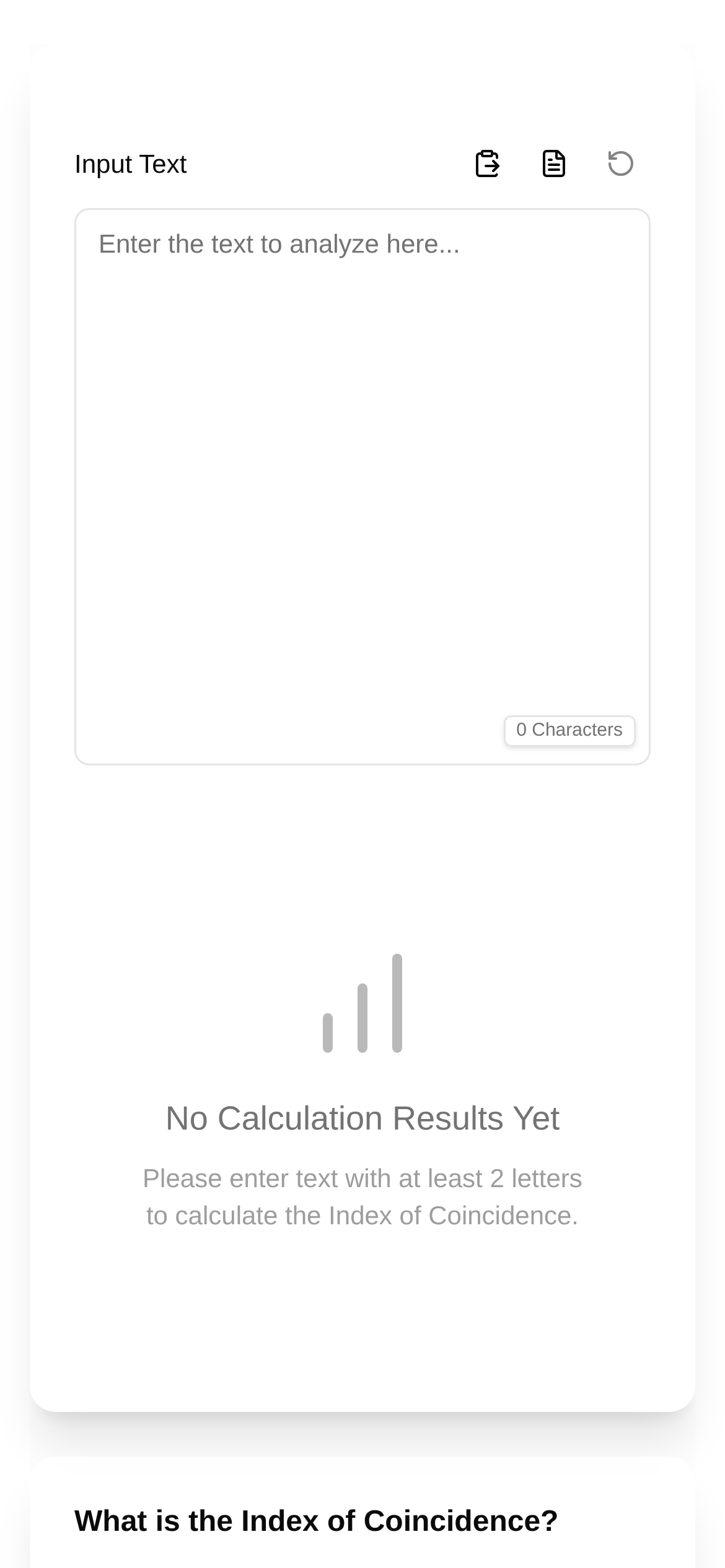
Have you ever wondered what patterns hide behind the English letters we see everywhere? In fields like linguistics, cryptography, and even artificial intelligence, letter frequency statistics play a crucial role. Today, I want to introduce a highly useful tool—the Index of Coincidence Calculator—which can help you uncover many of these secrets.
What Can This Tool Do? Examine the "Skeleton" of Text
Imagine you have an encrypted English text, or you are studying the statistical properties of a specific language. Simply counting how many times each letter appears might only give you a surface-level impression. However, by using the Index of Coincidence (IC), you can gain a much deeper understanding of the text's internal structure.
Simply put, the Index of Coincidence measures the probability that two randomly selected letters from a text are identical. A higher value usually indicates that the text is less random and is likely a natural language. For example, standard English has an IC of about 0.067, whereas a completely random sequence of 26 letters has a much lower IC, around 0.038.
This metric is incredibly useful in cryptanalysis! You can compare the IC of a ciphertext with the known IC of various languages. This allows you to make an educated guess about how the text was encrypted or even identify the underlying language. Additionally, it serves as an important clue for language identification, helping us distinguish between different languages.
Who Uses This Tool? See If It's for You
- Cryptography Enthusiasts and Beginners: If you are interested in classical ciphers like the Vigenère or Caesar cipher, the Index of Coincidence is an absolute must-have for analyzing ciphertext and finding key lengths. It helps you quickly determine if a ciphertext uses monoalphabetic substitution, narrowing down your analysis.
- Linguistics Researchers: When conducting corpus analysis or studying the statistical features of different languages, the IC provides a quantifiable metric to help compare the internal structures of various languages.
- Text Analysts: For those who need to quickly determine if an unknown text belongs to a specific language or evaluate the randomness of text content.
- Curious Minds: Anyone who wants to dive into the statistical patterns of language or simply experience the thrill of "decryption."
How to Use It? Quick Setup, Effortless Analysis
Using the Index of Coincidence Calculator is incredibly simple. Even if it's your first time using such a tool, you'll master it instantly:
- Open the Tool Page: Enter
https://www.toolkk.com/tools/index-of-coincidence-calculatorin your browser to access the calculator. - Paste Your Text: Paste the English text you want to analyze into the text input box on the page. This can be any English paragraph, encrypted text, or even a random string of letters.
- Click Calculate: Simply click the prominent "Calculate" or "Analyze" button.
- View the Results: The tool will instantly display the calculated Index of Coincidence (IC value) along with the frequency statistics for each English letter in the text. With this data, you can proceed with your analysis.
"How do I use the Index of Coincidence Calculator?" It's that simple! It automatically handles the complex mathematical calculations for you; all you need to do is provide the text. As for an "Index of Coincidence Calculator tutorial," the operations are so intuitive that there's virtually no learning curve.
Frequently Asked Questions (FAQ)
- Q: Who is the Index of Coincidence Calculator for? A: As mentioned earlier, it is highly suitable for cryptography enthusiasts, linguistics researchers, text analysts, and anyone interested in the statistical properties of language.
- Q: Can this tool identify non-English text? A: Currently, this Index of Coincidence Calculator is primarily designed for English letter frequency statistics. While the concept of the Index of Coincidence applies to all languages, different languages have unique alphabets and statistical traits, requiring specific adjustments to calculation methods and reference values. Therefore, for Chinese or other non-Roman alphabet languages, you will need specialized tools or methods.
- Q: What is the difference between the Index of Coincidence and letter frequency? A: Letter frequency statistics tell you how many times each letter appears or its percentage, while the Index of Coincidence is a more advanced metric. Based on letter frequency, it calculates the probability that two randomly selected letters in a text are identical. The IC better reflects whether a text is "language-like" or "more random."
- Q: How can I tell if a ciphertext has been successfully decrypted? A: After attempting to decrypt a ciphertext, you can compare the IC of the decrypted text with the IC of a known language (like English). If the two values are very close, congratulations—you have likely found the correct decryption method or key!
- Q: Are there other tools similar to the Index of Coincidence Calculator available? A: There are indeed other online cryptanalysis tools on the market that integrate IC calculation features. However, the advantage of this tool is its focus and simplicity, allowing you to get core data quickly. Which tool you choose ultimately depends on your specific needs and preferences.
Things to Keep in Mind
When using any statistical analysis tool, remember one thing: data is the foundation, but analysis is the key. The Index of Coincidence is a powerful supplementary tool, but it cannot replace your own logical reasoning and domain expertise. Especially when dealing with complex encryption methods or highly scrambled text, you may need to combine several analytical methods to reach an accurate conclusion.
In short, the Index of Coincidence Calculator is a compact yet fully-featured online tool that helps you view text data from a whole new perspective. Whether you are performing cryptanalysis or exploring the mysteries of language, it will become an indispensable companion. Give it a try and experience the charm of language hidden behind the data!