

Tool Interface Preview
Poland Address Generator
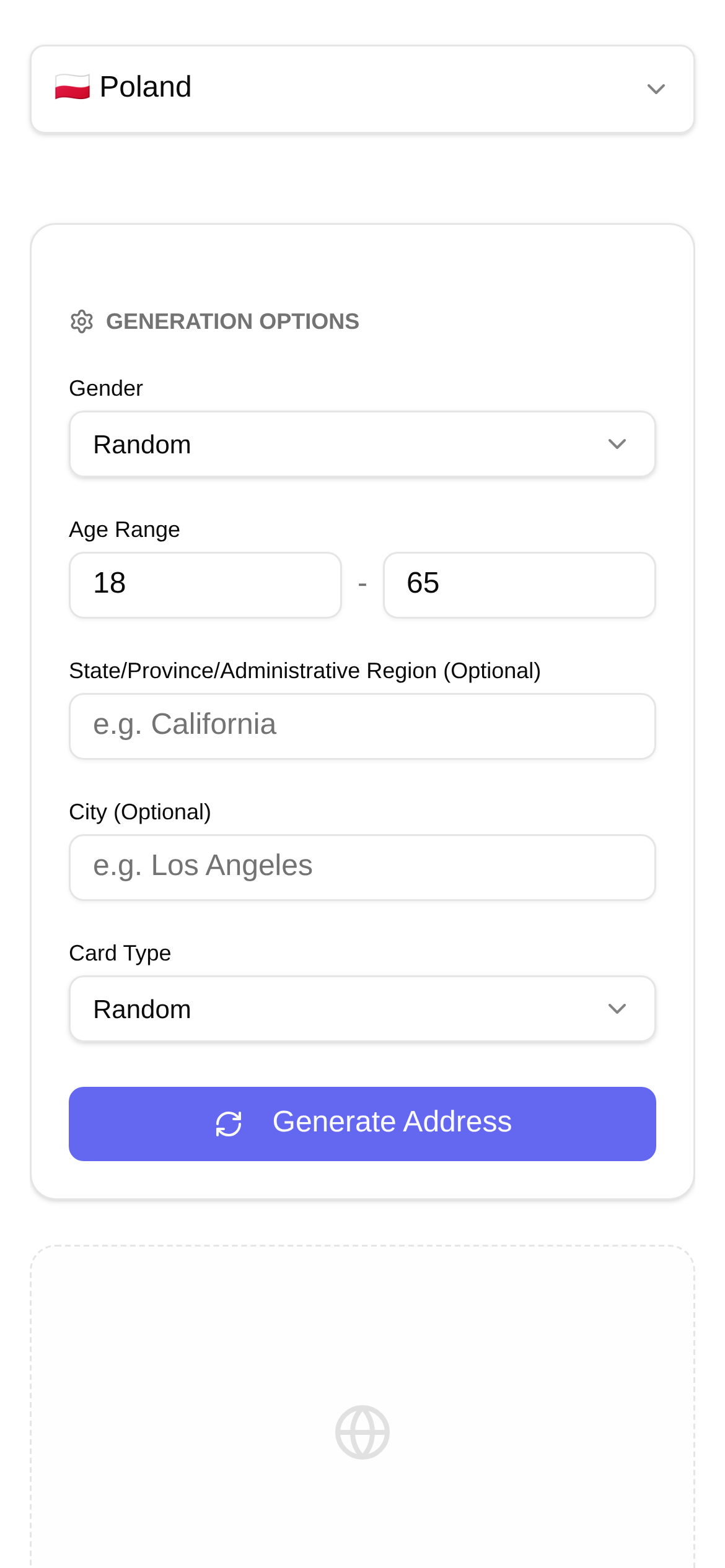
In software development, the quality of test data is absolutely critical. It directly affects the stability of our final product and the user experience. To be honest, we often take the easy way out by typing in random data or writing a simple loop to brush it off. The problem is, this kind of "fake data" is usually very monotonous and completely fails to cover complex business scenarios. The result? Bugs slip through the testing phase and only pop up after going live, which is a huge hassle and incredibly costly.
Ultimately, how can we quickly and efficiently obtain high-quality, realistic test data? That's quite a technical challenge.
1. Why is Realistic Test Data So Important?
Think about it: if you're working on an e-commerce platform and your test data only consists of "Product A, Product B" and "User 1, User 2", you won't be able to foresee how the system reacts when a user enters an invalid address format, a product name is too long, or an order amount becomes negative. Realistic data simulates the complexity of user operations, business logic, and data distribution. This brings several benefits:
- Skyrocketing Test Coverage: We can test edge cases, exceptions, and various random combinations.
- No Hiding Place for Hidden Bugs: Realistic data often contains unexpected formats, lengths, and special characters, helping us unearth potential issues.
- Soaring Testing Efficiency: No more wasting hours manually constructing data and exhausting yourself. Testers can focus on testing logic rather than data preparation.
- More Robust Systems: Ensures our system remains rock-solid when facing various real-world data inputs.
- Effective Performance Testing: Large-scale realistic data better simulates real user loads, revealing how much the system can handle under high concurrency.
2. Ditch "Fake Data" and Embrace Flexible Data Generation
There are actually quite a few ways to generate realistic test data. Here are some common methods:
- Desensitized Production Data: This involves masking real data from the production environment. The advantage is that the data structure and distribution characteristics remain intact, but the risk is incomplete masking that leaves sensitive traces behind.
- Data Synthesis Tools: I absolutely love using these tools. They generate data based on preset rules, patterns, or algorithms, perfectly balancing realism, diversity, and security.
- Fuzzing: This is mainly used in security testing. It randomly generates a massive amount of invalid, abnormal, or unexpected inputs to see if it can expose software vulnerabilities.
Today, let's focus on how to use data synthesis tools to generate realistic data in specific formats, like addresses, names, and phone numbers, which are highly practical.
3. Practical Example: Using a Poland Address Generator
In many international projects, we often need to test address formats for different countries and regions. Manually making them up is time-consuming, prone to errors, and fails to guarantee realism. This is where professional address generation tools come in handy.
1. What exactly does this tool do?
Let's take this Poland Address Generator (https://www.toolkk.com/tools/random-poland-address-generator) as an example. It is specifically designed to generate random virtual addresses that conform to Polish formatting rules. With a single click, complete Polish address details like street, building number, postal code, city, and province are generated. It couldn't be more convenient.
2. When should you use it?
It has a wide range of applications:
- International Software Testing: For example, if your e-commerce platform, CRM system, or logistics software is expanding to support Polish users, you'll need a large amount of Polish address data to test registration, ordering, and delivery functions.
- Frontend Form Validation: This tool is a huge help in verifying whether frontend address input fields handle format validation and length limits correctly.
- Data Seeding: Easily and conveniently populate your database or test environment with realistic Polish address samples.
- Privacy Protection: During demonstrations or training sessions, when you want the data to look real but cannot use actual personal information, this tool perfectly avoids privacy risks.
- Stress Testing: Generate a massive batch of different Polish addresses to simulate high-concurrency requests and see how the system performs under heavy load.
3. How does it work?
Using this Poland address generator is incredibly simple. It only takes a few steps:
- Open the tool: Enter this link in your browser: https://www.toolkk.com/tools/random-poland-address-generator.
- Click "Generate": The interface is very clean. You'll typically see a "Generate" button. Just click it.
- Get the results: The page will instantly display one or more complete Polish addresses, including the street, building number, postal code, city, and province. You can copy and use them directly.
- Batch Generation: Some tools also allow you to set the generation quantity. For instance, if you need 100 Polish addresses to test a logistics system, just set it to 100 to save time and effort.
How to use the Poland Address Generator? Just follow these few steps. No registration or complex setup is required. It's ready to use right out of the box, making it perfect for quickly whipping up test data.
4. FAQs and Quick Tips:
- Data Realism and Privacy: These tools generate "virtually real" data, meaning it conforms to real-world formatting rules but does not point to any actual person or address. Therefore, you can use it for testing with complete peace of mind, without worrying about privacy leaks.
- Who is it for? Software QA engineers, developers, data analysts, product managers—anyone who needs to simulate realistic data to validate a system will find it useful.
- Compared to other tools: While general-purpose data generators like the Faker library exist, a dedicated address generator definitely has the upper hand when it comes to the accuracy of specific country/region address formats. It better simulates local address structures and postal code rules, making it closer to reality.
- Things to note: Although the generated data format is highly realistic, it does not guarantee that the address is completely valid in the real world (e.g., a specific street number might not actually exist). Its main purpose is to provide test data that complies with formatting standards, not for actual mailing purposes. Keep this in mind.
4. A Quick Summary
Generating realistic and diverse test data is absolutely a critical step in improving software quality. By utilizing various data synthesis tools, like the Poland Address Generator we discussed today, developers and testers no longer have to struggle with manually fabricating data. This allows us to verify software functionality more efficiently and comprehensively, ultimately delivering a more stable and robust product. During your next development iteration, why not give these tools a try and bring your test data to life!
This content is just for reference and cannot replace professional testing and development advice. Before using it in critical business systems, be sure to thoroughly validate it yourself—don't cut corners!