

Tool Interface Preview
Random Germany Address Generator
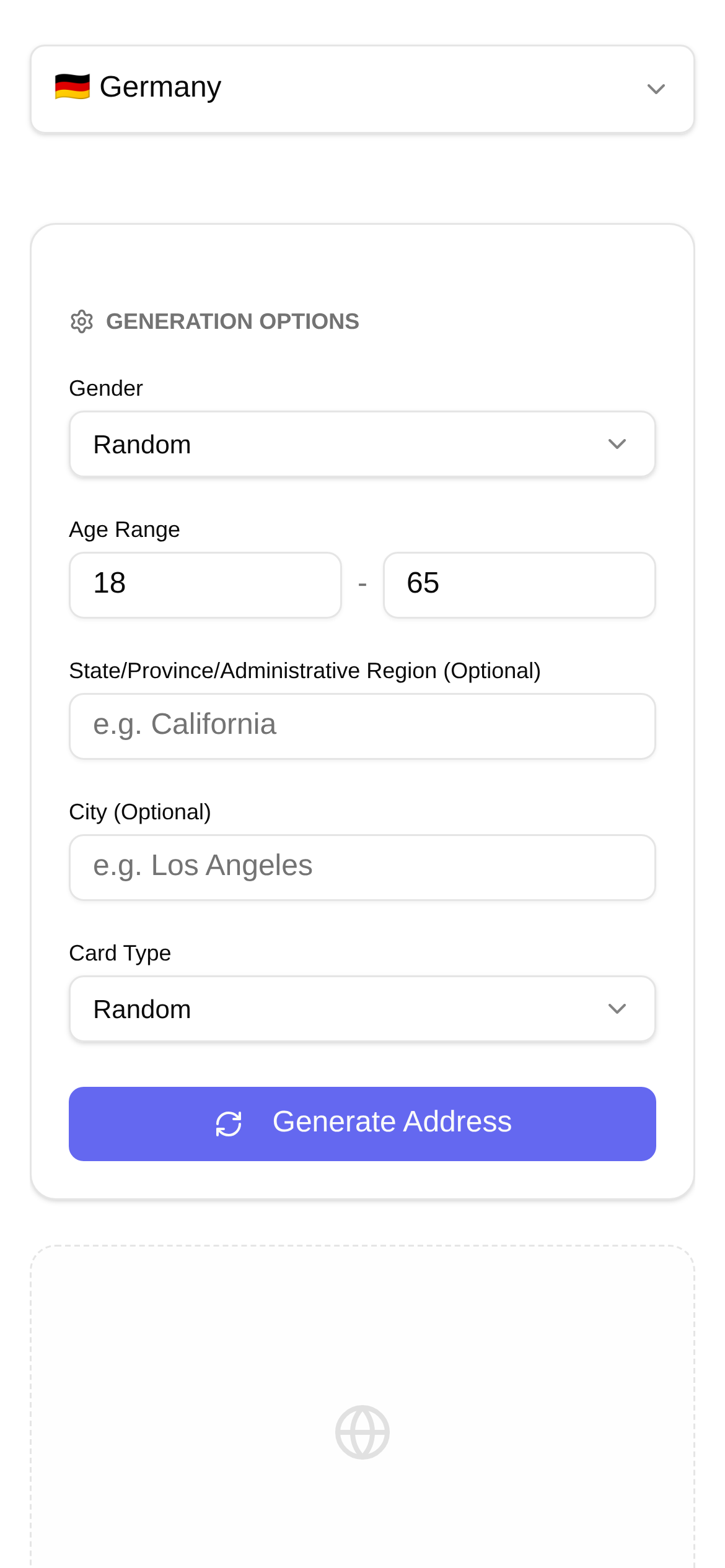
Living or working in Germany, or doing business with German companies, have you ever been confused by German addresses? A seemingly simple address actually hides many local conventions and postal rules. If the address is written incorrectly, not only will mail and packages fail to arrive, but it can also make you look unprofessional in formal situations. Today, we'll discuss exactly how to write a German address correctly, and introduce a highly practical tool to help you get it right effortlessly!
What Does a German Address Look Like? Components and Structure
German addresses follow a relatively fixed set of rules designed to ensure your mail and packages are delivered accurately. Unlike many places where the house number comes before the street name, German addresses typically list the street name first, followed by the house number. A standard address includes the following key components:
- Recipient Name (Empfängername): Usually the full name. If it's a company, write the company name.
- Street Name and House Number (Straße und Hausnummer): This is the core part. The street name comes first, followed by the house number, typically separated by a space. For example: Musterstraße 12.
- Additional Address Information (Zusätzliche Adressinformationen): If the recipient lives in an apartment building, you might need to add the floor, apartment number, or a C/O (care of). For example: c/o Max Mustermann or App. 3B.
- Postal Code and City (Postleitzahl und Ort): The postal code (Postleitzahl, or PLZ for short) is a five-digit number, immediately followed by the city name. For example: 12345 Berlin.
- Country (Land): For international mail, remember to include the country name, usually Deutschland or Germany.
For Example:
Frau Anna Schmidt Musterstraße 12 12345 Berlin Deutschland
When Do You Need a Correct German Address? Common Scenarios
Mastering the correct format for German addresses is crucial in many situations:
- Cross-Border Shopping and International Shipping: Whether sending packages or letters to friends in Germany from abroad, writing the address correctly is the first step to successful delivery.
- Business Communications: When dealing with German companies, sending contracts, or shipping goods, a professional address format reflects well on your business.
- Studying Abroad or Immigration: When applying to schools, processing residence permits, or receiving bank cards and important documents, address accuracy is paramount.
- Travel and Accommodation: Providing an accurate address makes confirmation and navigation easier when booking German hotels or vacation rentals.
- Development Testing and Data Population: For developers, generating a large number of random addresses that conform to German formatting to test systems or populate databases is a common requirement. This is exactly where the tool we are introducing today comes in handy.
How to Use the Random Germany Address Generator? Features and Guide
To help you efficiently obtain data that complies with German address formats, I highly recommend a practical online tool: the Random Germany Address Generator. This tool not only generates random addresses but also helps you better understand the structure of German addresses.
Tool Link: https://www.toolkk.com/tools/random-germany-address-generator
Introduction: This tool generates random address data in standard German formats, making it ideal for development testing, data population, or privacy protection scenarios. Whether you need to mock user data or require a realistic German address format to validate your system, it has you covered.
How to Use:
- Open the Tool Page: Click the link above to access the Random Germany Address Generator.
- Select the Quantity: The page usually allows you to choose how many addresses to generate at once. Select based on your needs, such as 1, 5, or more.
- Click Generate: Click the prominent "Generate" button.
- View Results: The tool will instantly display a list of generated German addresses on the page. Each address follows the correct German format, including street, house number, postal code, and city.
- Copy and Use: You can directly copy these addresses and paste them into your application, test scripts, or wherever needed.
Why Use This Tool?
- Standardized Formatting: The generated addresses fully comply with German address formatting standards.
- Diverse and Random: Each generation provides different addresses, ensuring data variety.
- Easy to Use: The interface is intuitive and requires no complex setup—just one click.
- Privacy Protection: When you need to test but want to avoid using real personal information, this tool is incredibly useful for preventing privacy leaks.
Frequently Asked Questions and Reminders
-
Q1: Are these generated addresses real? A1: The Random Germany Address Generator creates "mock" addresses that follow formatting rules. They look real but do not correspond to actual residents in real life. Therefore, never use these generated addresses to send actual mail or apply for services, as they may result in delivery failures or legal risks. They are primarily for learning, testing, and data population.
-
Q2: How does the German address format differ from US or UK addresses? A2: The biggest difference is the order of the street name and house number. Germany uses "Street Name + House Number," whereas countries like the US and UK typically use "House Number + Street Name." Additionally, the length and format of postal codes differ.
-
Q3: How do I distinguish between a business address and a residential address? A3: There is no fundamental difference in the format; it mainly depends on the recipient line. Business addresses usually list the company name (e.g., Siemens AG), while residential addresses list the individual's name (e.g., Herr Max Mustermann). If it needs to be forwarded, you would use z. Hd. (zu Händen) or c/o.
-
Q4: What should I keep in mind when using the Random Germany Address Generator? A4: Always remember its "randomness" and "non-reality." It is a supplementary tool to help us understand and test, but it should not be used for sensitive operations in actual production environments.
-
Q5: Are there other similar tools to compare? A5: There may be other address generation tools on the market, but the advantage of this Random Germany Address Generator is its strict focus on German address standards and its incredibly simple operation.
Understanding how to correctly write a German address is a foundational skill when dealing with Germany. With a handy tool like the Random Germany Address Generator, whether for learning, testing, or development, you can get twice the result with half the effort. We hope today's guide helps you better understand and utilize German address formats!
Important Disclaimer: All information and tools mentioned in this article are for reference and educational purposes only. If actual mailing, legal matters, or business transactions are involved, please be sure to verify the accuracy and validity of the address and comply with relevant regulations. We are not responsible for any consequences arising from the improper use of the tools or information provided.