

Tool Interface Preview
Time Unit Converter
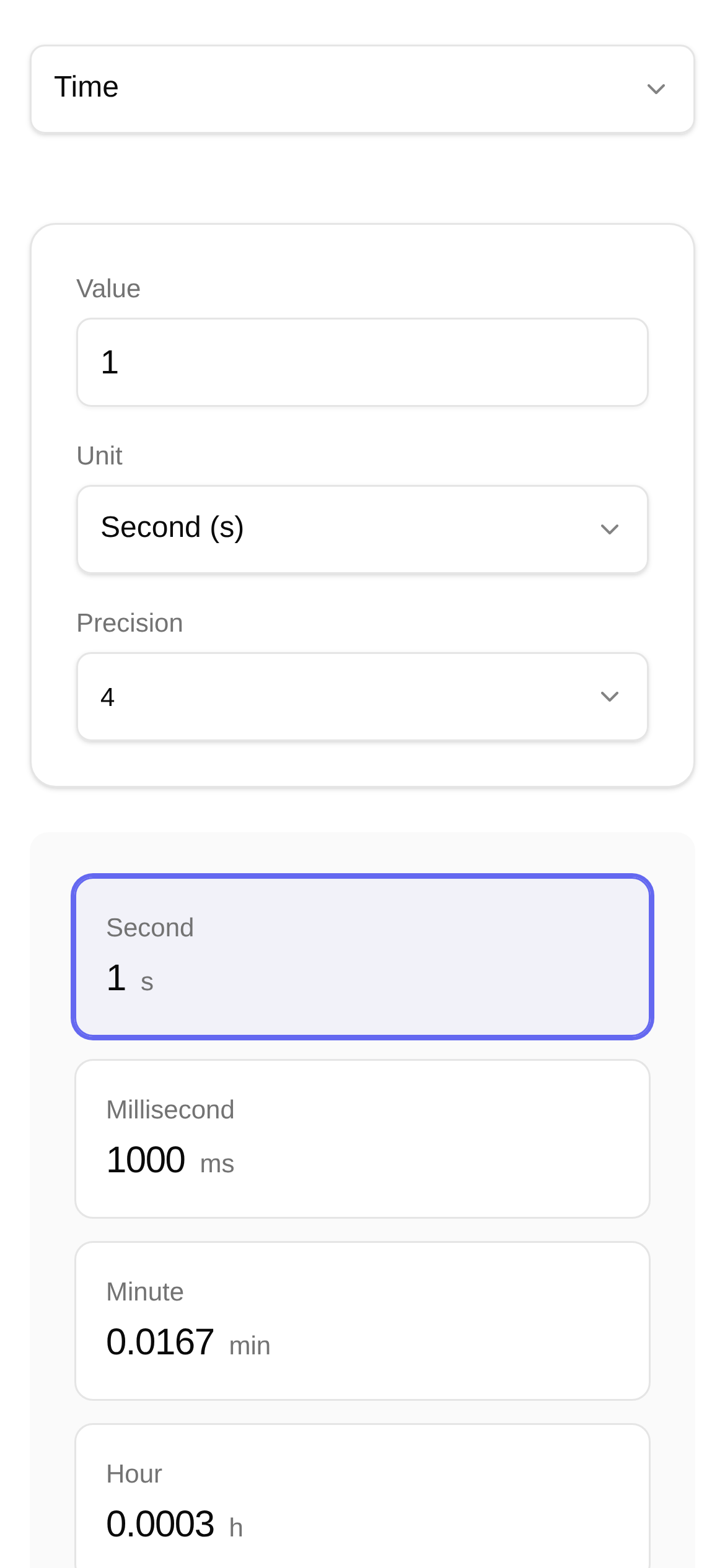
Have you ever gotten a headache just thinking about time unit conversions? For example, exactly how many seconds are in a minute, or how many hours are in a day? Honestly, whether you're a student, an office worker, or just going about your daily life, being able to accurately understand and quickly convert time units is pretty important. Today, I want to talk about everything related to time units and recommend a super handy tool I found. I guarantee you'll never have to worry about time conversion again!
⏳ Time Units: From Beginner to Master
The units we interact with most often are definitely seconds (s), minutes (min), and hours (h). They form the backbone of our daily routines. But the world of time doesn't stop there. On a larger scale, we have days (day), weeks (week), months (month), and years (year); on a smaller scale, there are milliseconds (ms), microseconds (μs), and nanoseconds (ns). While we might not use the latter in everyday life, they are the absolute main characters in high-tech fields like scientific computing and engineering measurements.
To understand how to convert them, you first need to grasp their relationships:
- 1 minute = 60 seconds
- 1 hour = 60 minutes = 3600 seconds
- 1 day = 24 hours = 1440 minutes = 86400 seconds
- 1 week = 7 days
- 1 year ≈ 365.25 days (This accounts for leap years and is more accurate)
As for the smaller units, they operate on a base-1000 system:
- 1 second = 1000 milliseconds
- 1 millisecond = 1000 microseconds
- 1 microsecond = 1000 nanoseconds
If you rely purely on your brain or a standard calculator to figure these out—especially with large numbers or decimals—it can be exhausting and prone to errors. That's when having a reliable tool becomes crucial. I recently discovered a Time Unit Converter that is an absolute lifesaver! Whether it's years, weeks, days, hours, minutes, seconds, milliseconds, microseconds, or nanoseconds, it handles them instantly. You can even customize the number of decimal places for whatever level of precision you need.
🗓️ Who Needs a Time Unit Converter? Everyone!
You might think this is only for scientists, right? Wrong! Its applications are incredibly broad, penetrating almost every aspect of our lives:
- Students: Calculating periods in physics experiments, solving for speed in math problems, or planning daily study schedules—you can't do it without time conversions.
- Office Workers: Project managers need to estimate task durations. You need to know how long a meeting will last. Even calculating overtime pay requires precision down to the hour and minute.
- Programmers/Engineers: They require much higher time precision, such as timing how long a piece of code takes to run (often just a few milliseconds) or analyzing timestamps in system logs. These tiny units are incredibly important.
- Researchers: Processing experimental data, running model simulations, and performing time-series analysis are everyday tasks.
- Everyday Users: Even if you're just planning a trip, calculating time differences across time zones, or simply curious about "exactly how many hours are in two years?", this tool can help.
So, whether you want to know "how to use a time unit converter" or are looking for a "time unit conversion tutorial," this tool has you covered. As long as you have even the slightest need for time precision, or just want to make time calculations easier, it's perfect for you.
🚀 Follow Me: Master Time Unit Conversion in 3 Steps
Using this Time Unit Converter is super fast. Even if you're a complete beginner, you'll understand it instantly:
- Click the link: Just click this link https://www.toolkk.com/tools/time-unit-converter to open the conversion page.
- Enter the value: In the "Input Value" field, type the specific amount of time you want to convert, such as "1.5" hours or "3600" seconds.
- Select the units: Next, in the "Original Unit" dropdown menu, select the unit corresponding to the number you just entered—is it "Hours"? "Seconds"? Or "Days"? Then, go to the "Target Unit" menu and select the unit you want to convert to, like "Minutes", "Milliseconds", or "Years".
- View the results: Once you've made your selections, the tool will instantly display the converted result. If you need specific precision, you can also adjust the "Decimal Places" to get exactly what you need.
Compared to punching numbers into a calculator for ages or doing manual math, this tool is incredibly convenient: it's fast, accurate, and easy to operate, significantly reducing the chance of making mistakes. When it comes to solving "time unit conversions," it's definitely a powerful assistant!
❓ Frequently Asked Questions About Time Unit Conversion
-
Q1: Sometimes the conversion results in a decimal. Is this normal?
- A1: Completely normal! Just like half an hour is expressed as 0.5 hours, but converted to minutes, it's 30 minutes. As long as it's not an exact multiple, decimals are very common. This tool also lets you set your own decimal places, so you can be as precise as you want.
-
Q2: Do leap years affect time conversions?
- A2: Yes, if you're converting "years" to "days," leap years do have an impact. A standard year has 365 days, but a leap year has 366. However, when handling "year" conversions, this Time Unit Converter generally uses a more precise average, such as 365.25 days, making the results more accurate. But if you're calculating for a specific year and require extreme precision, you might need to factor in whether that specific year is a leap year yourself.
-
Q3: When would anyone ever use super small units like milliseconds, microseconds, and nanoseconds?
- A3: These units are primarily used to measure incredibly short time intervals. For example, in a computer, a CPU might execute an instruction in just a few nanoseconds; network transmission latency might be a few milliseconds. They are also used in physics for particle decay and in electronic engineering for signal transmission. We ordinary folks might not use them daily, but learning about them is a great way to expand your knowledge.
-
Q4: Does this time unit converter cost money?
- A4: No, time unit converters like this are usually free online tools, designed simply to provide convenience for everyone.
After reading these tips and using this great tool, I believe your understanding of time units has definitely deepened, and converting them will be a breeze. Say goodbye to tedious manual calculations and make your study and work faster and more accurate!
Quick reminder: Everything I've shared is based on general knowledge and experience using the tool, and does not constitute professional advice. If you have needs in highly specialized fields, it's best to consult relevant experts.