

Tool Interface Preview
Random France Address Generator
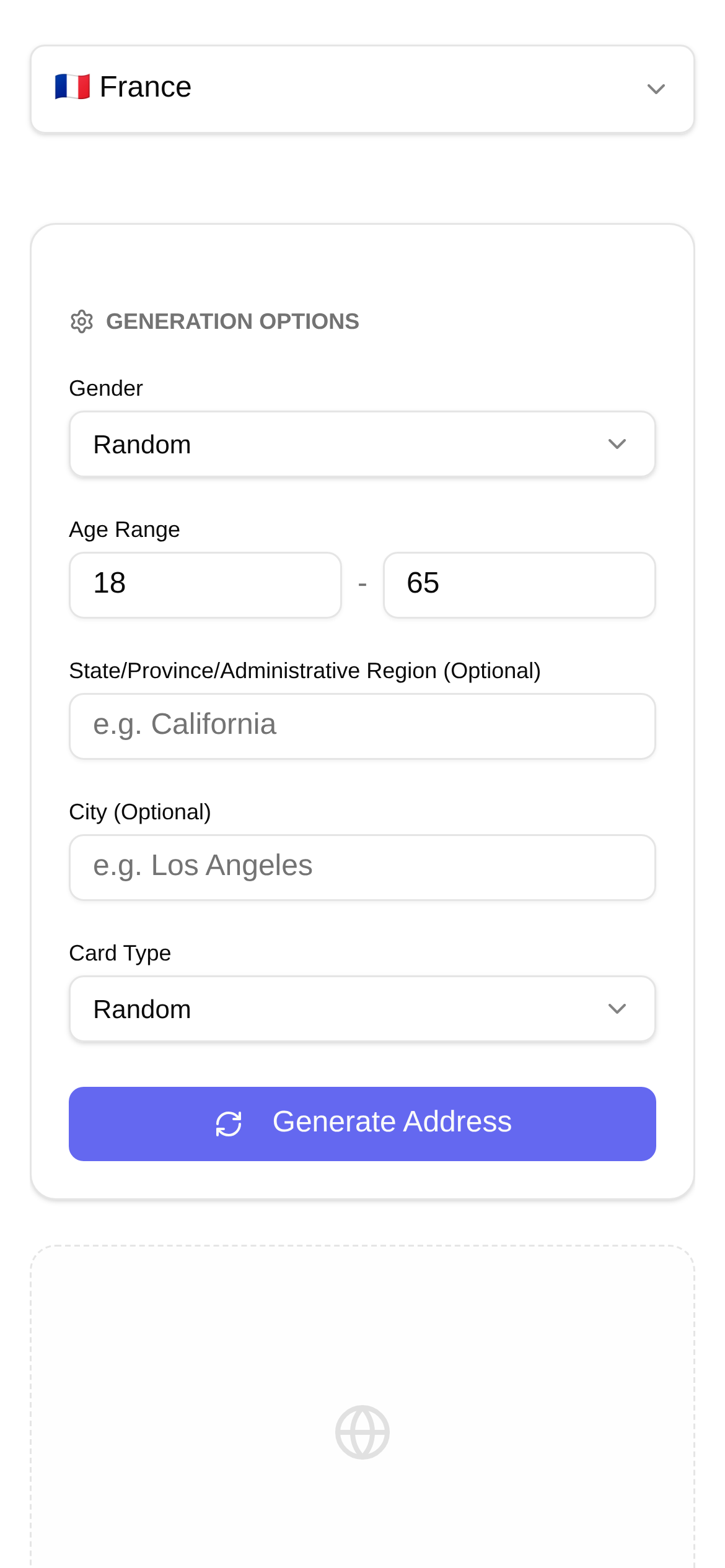
Are French Address Test Data Giving You a Headache?
As a developer or tester, dealing with French address fields can be a real headache. Typing them manually is time-consuming and tedious, while making them up randomly often leads to incorrect formats that are completely unusable. Especially now that apps are going global, address formats vary wildly from country to country. If your test data doesn't match local standards, you could easily bury a bunch of unexpected bugs in your system.
Why is Getting French Addresses Right So Important?
French addresses might look simple, but they are actually quite complex. For example, the postal code (Code Postal) is five digits, city names (Ville) are incredibly diverse, and there are specific naming conventions for departments (Département) and regions (Région). Add to that the various street types (like Rue, Avenue, Boulevard) and street number combinations, and it's easy to make a mistake. If your test data isn't realistic, you're in for some serious trouble:
- Failed Form Validation: Many systems have strict requirements for address formats. A randomly typed address will likely be rejected outright.
- Database Insertion Errors: The field length and data types reserved for addresses in your database might not align with real addresses, resulting in truncated data or complete insertion failures.
- Skewed Business Logic: Business logic that relies on addresses, such as calculating shipping costs or zoning, will definitely yield incorrect results if the addresses are wrong.
- Poor User Experience: If issues aren't caught during testing, real users will face a terrible experience once the product goes live.
Therefore, to improve software quality, generating standardized and diverse virtual French addresses is an absolutely crucial step.
One-Click Solution: This [Random France Address Generator](https://www.toolkk.com/tools/random-france-address-generator) is Amazing!
Today, I want to recommend an incredible tool specifically designed to solve this pain point: the Random France Address Generator. It helps you generate various standardized virtual French addresses, making it incredibly useful for testing, development, and privacy protection.
It generates comprehensive information, covering everything from street types, street names, and street numbers to postal codes, cities, departments, and even regions. Moreover, this data isn't just randomly thrown together; it's based on real French geographical information structures. This ensures the generated addresses are both realistic and practical, unlike those useless, completely fake random strings.
Who Needs This Tool? Let's Break It Down
- Software QA Engineers: If you need a large volume of French address data for form filling, data importing, or testing internationalization features, this is your lifesaver.
- Front-end/Back-end Developers: When you want to simulate user input during development to test the validation and storage logic of address fields, you can't go wrong with this.
- Data Analysts: If you're doing data anonymization or creating mock datasets and need realistic address information to fill them, this tool is a huge help.
- Privacy-Conscious Users: When giving presentations or sharing screens, you can use virtual addresses instead of exposing real ones for added security and convenience.
- Teaching/Demonstrations: It's also a great choice for teaching students about the format and structure of French addresses or for use in live demos.
How to Use It? It's Incredibly Simple!
This tool is extremely convenient to use. No registration or login is required; just open it and start using it right away:
- Open the Webpage: Simply enter https://www.toolkk.com/tools/random-france-address-generator in your browser.
- Select the Quantity: The page will ask if you want to generate one or multiple French addresses at once. There is usually a dropdown menu or input box; just choose according to your needs.
- Click "Generate": Find the "Generate" button and click it.
- Get Your Results: The page will instantly display a list of French addresses with complete information. What you see is what you get.
- Copy and Paste: Just copy these addresses and paste them into your test cases, code, or anywhere else you need them.
For example, you might get an address like this: 23 Rue de la République, 75001 Paris, Île-de-France. As you can see, the street number, street type, street name, postal code, city, and department (or region) are all there, perfectly matching French address standards.
A Few Quick FAQs
- Are these addresses real? Let's put it this way: they are "virtual" but "properly formatted." This means they look exactly like real French addresses, but they don't actually point to a real person or company. They are mock data meant for testing and development.
- Will the addresses repeat? When generating large amounts of data, the tool tries to ensure variety. However, because it's random, there might be occasional duplicates, especially when generating massive quantities. But for everyday testing, this small probability has virtually no impact.
- Can I generate addresses for a specific region? Currently, this Random France Address Generator primarily generates random addresses nationwide. If there's a need for more granular control in the future, keep an eye on tool updates—filtering by department or city might be added.
- What are the advantages over writing addresses manually? Writing addresses manually is not only slow but also prone to errors, and it's hard to guarantee the correct format. This tool can quickly and accurately generate batches of standardized addresses, massively improving efficiency and data quality. It's a qualitative leap.
- Who is this tool for? As long as you are in development or testing, need French address test data, and don't want to create it manually or use sensitive real data, this tool is tailor-made for you. Everyone from junior developers to senior test architects can benefit from it.
With this tool, handling internationalized address data is incredibly convenient. Developers and testers can finally focus their energy on core business logic instead of worrying about tedious test data. Say goodbye to manual typing and embrace efficiency!