

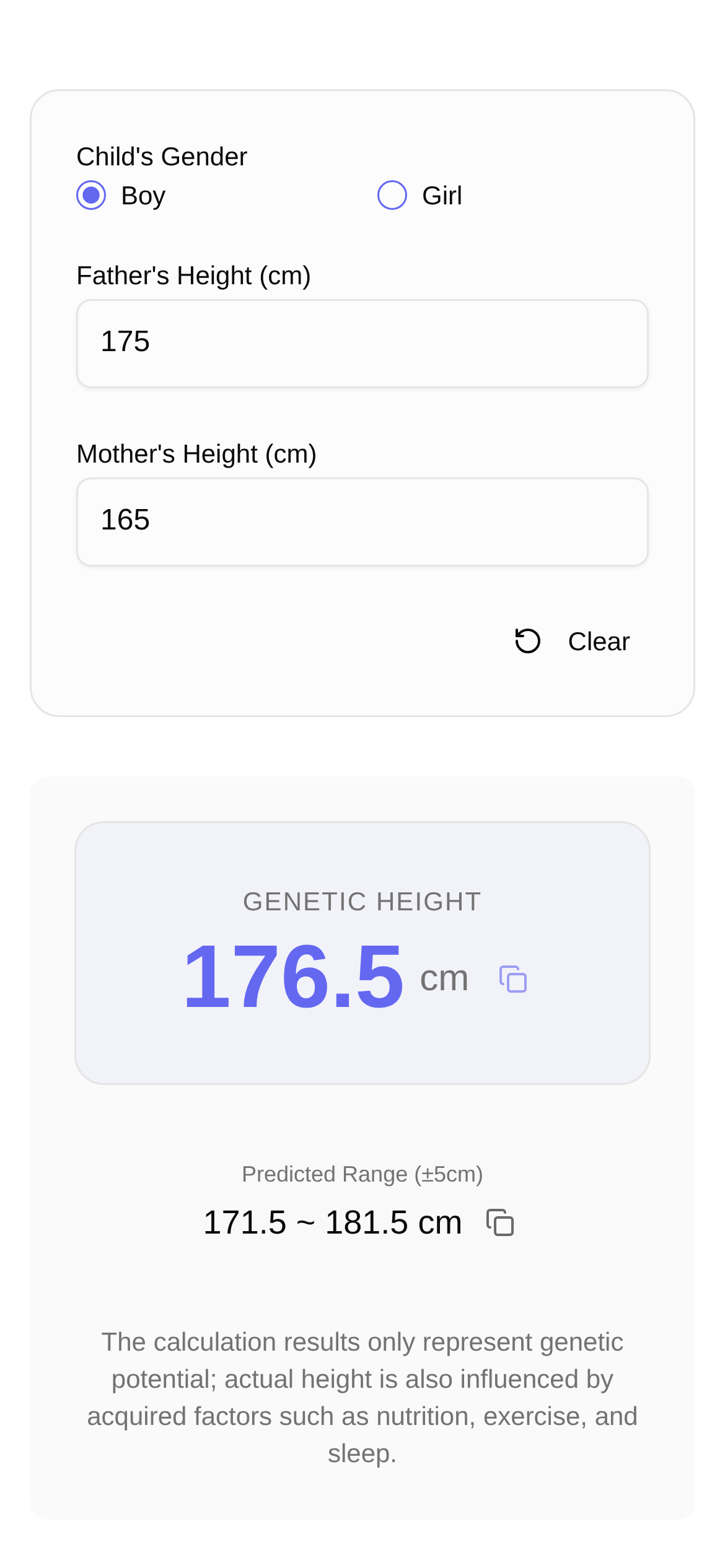
Tool Interface Preview
Child Height Predictor Calculator
"How tall will my kid be?" What parent hasn't wondered this a thousand times? From the moment our children are born, our eyes turn into measuring tapes, constantly tracking their growth curves for fear of missing any key factor that affects their height. At gatherings with friends, we inevitably compare our kids, occasionally blurting out, "Wow, your child has such long legs, they'll definitely be tall!" This expectation and slight anxiety about height are, ultimately, just part of our daily lives as parents.
Honestly, is predicting a child's height actually reliable?
We've all heard the old adages passed down from older generations, like "tall parents mean tall kids" or "boys grow later than girls." We've heard them so often our ears are ringing, but is there any scientific basis to them? Can we really estimate a child's adult height with relative accuracy? The answer is yes, though you shouldn't expect 100% precision. Modern science, combining genetics, statistics, and the laws of growth and development, has indeed developed a relatively mature prediction model. These models take core factors like parental height genetics and the child's gender into account to provide an estimated height range, rather than a rigid number.
Let's uncover the science behind height prediction
The most commonly used method for predicting height is called the Target Height Method, also known as the genetic height method. Its core premise is that a child's adult height is significantly influenced by their parents' heights. How is it calculated? It usually uses a fairly simple formula:
- For boys: Target Height = (Father's Height + Mother's Height + 13) / 2 ± 6.5 cm
- For girls: Target Height = (Father's Height + Mother's Height - 13) / 2 ± 6.5 cm
The "± 6.5 cm" part tells us that the final height may fluctuate above or below this calculated average; after all, genetics always involve some variables. Of course, besides genetics, acquired factors like a child's nutrition, sleep quality, exercise, illnesses, and surrounding environment will all affect their final height. Therefore, this prediction result reflects a "genetic potential" rather than a "set-in-stone final height."
Want to easily predict your child's height? Try this calculator!
To help parents understand their child's growth potential more intuitively, some very convenient tools have appeared on the market. For example, this Child Height Predictor Calculator is quite practical. It primarily predicts the possible adult height range of a child based on the parents' heights and the child's gender, providing parents with a reference for growth trends.
When is the best time to use this tool?
For new parents who just had a baby and are curious about their child's future height trajectory, using it as an initial reference for parenting planning is great. If you notice your child is growing a bit too fast or too slow, you can also compare it with this prediction result to see if they are within a normal range. If the difference is too large, you can consult a doctor in a timely manner. Some parents even use the predicted height to form a preliminary idea of whether their child is suited for certain sports specialties or career paths in the future (though, of course, this is definitely not the only deciding factor).
It's very simple to use:
- Open the link: Simply visit https://www.toolkk.com/tools/child-height-calculator.
- Enter information: The page will prompt you to input the father's height, the mother's height, and then select the child's gender.
- View results: Click the "Calculate" button, and you will immediately see a predicted adult height range.
Frequently asked questions and a few quick tips:
- "Is the Child Height Predictor Calculator accurate?" This tool is based on scientific genetic height formulas, so it has significant reference value for predicting genetic factors. However, keep in mind that it provides a potential range, not an absolute value. Acquired factors have a huge impact and can even change the final height.
- "How do I use this tool / is there a tutorial?" As explained in detail above, you simply enter the parents' heights and the child's gender. It's very straightforward.
- "Who is this tool for?" It is suitable for anyone interested in a child's height potential, especially parents who pay close attention to their child's growth and development.
- "How does it compare to other tools?" Most online height prediction tools are actually based on similar genetic height formulas, so the calculated results are pretty close. The key is understanding the science behind it and its limitations.
- "What should I keep in mind when using this tool?"
- For reference only: Its prediction results are just a reference and cannot replace professional medical advice. If you have any doubts about your child's height development, be sure to consult a pediatrician or an endocrinologist.
- Acquired efforts are essential: Predicted height is an innate genetic potential, but whether this potential can be fully realized depends on balanced nutrition, adequate sleep, sufficient exercise, and avoiding illnesses. These have a massive impact on final height, so parents should focus more on their child's daily healthy lifestyle habits.
- Use in conjunction with growth curves: Looking at a prediction result alone might not be comprehensive enough. If you can combine it with a child growth and development curve chart to observe the child's height growth trend, the reference value will be much greater.
Ultimately, these scientific tools can give us preliminary guidance, but the true essence of parenting lies in creating a healthy and happy environment for children to grow up in. This allows them to fully realize their growth potential. While height is certainly important, a child's health, confidence, and character are our most precious treasures.