

Tool Interface Preview
Antilogarithm Calculator
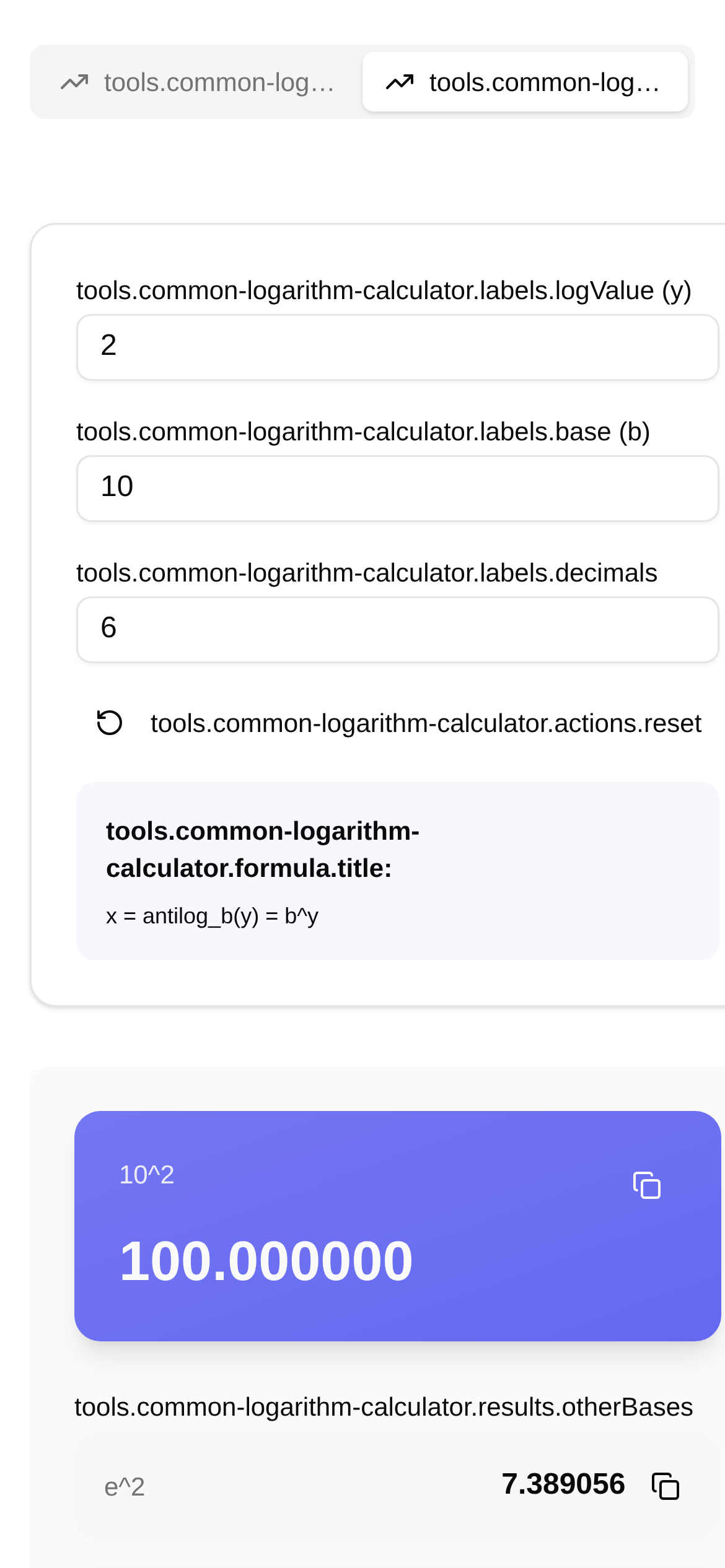
In mathematics, logarithms and antilogarithms go hand in hand. If logarithmic functions have ever left you confused, understanding antilogarithms might just be the key to making it all click. In this article, we will explore exactly what an antilogarithm is and introduce a highly effective tool to help you easily handle antilogarithm calculations, eliminating the headache of complex numerical operations once and for all.
What Exactly is an Antilogarithm?
Simply put, an antilogarithm is the inverse operation of a logarithm. Think about it: a logarithmic function essentially asks, "How many times must a specific base be multiplied by itself to get another number?" (For example, log₁₀100 = 2 asks how many times 10 must be multiplied to reach 100, and the answer is 2). An antilogarithm asks the exact opposite: "What do you get when you multiply a specific base by a certain power?" (For example, antilog₁₀(2) = 100 means 10 raised to the power of 2 equals 100).
In terms of mathematical formulas, it works like this:
If we know that log_b(x) = y, the corresponding antilogarithm is antilog_b(y) = x. To put it more straightforwardly, b^y = x.
The most commonly used antilogarithms typically use the following bases:
- Base 10 (Common Logarithm):
antilog₁₀(y)is simply10^y. This is incredibly common in engineering and scientific calculations. - Base e (Natural Logarithm):
antilog_e(y)ise^y. It is a familiar concept in fields like calculus, statistics, and probability theory. - Base 2 (Binary Logarithm):
antilog₂(y)equals2^y. Computer science and information theory simply couldn't function without it.
Understanding antilogarithms can genuinely help us solve a wide range of problems, especially those related to exponential growth, decay, and comparing different orders of magnitude. It is much more useful than you might think.
Real-World Applications of Antilogarithms
You might be wondering, apart from showing up in math textbooks, what else are antilogarithms good for? They are far from just theoretical concepts; they play a crucial role in many practical fields:
- Science and Engineering: Think about decibels in acoustics, pH levels in chemistry, or the Richter scale for earthquakes. These all use logarithms to represent extremely large or small numerical ranges. When we need to convert these logarithmic scale values back into actual physical quantities, antilogarithms come into play.
- Finance: When calculating compound interest growth or return on investment, we often use logarithmic functions for analysis. Once the analysis is complete, if you want to convert the results (logarithmic values) back into actual monetary amounts, you need to use antilogarithms.
- Data Analysis and Statistics: When dealing with highly skewed data distributions, we sometimes apply a logarithmic transformation to make it look closer to a normal distribution, which facilitates subsequent statistical analysis. After the analysis, to interpret the meaning of the original data, we must use antilogarithms to transform it back.
- Computer Science: Logarithms and antilogarithms are also indispensable when analyzing algorithm complexity or calculating information entropy.
In these scenarios, manually calculating antilogarithms is not only incredibly tedious but also highly prone to errors. This is where a reliable Antilogarithm Calculator becomes essential. It helps us get fast and accurate results, saving us from frustrating exponential calculations.
How to Use the Antilogarithm Calculator
To make calculating antilogarithms more convenient, we recommend this highly effective tool: the Antilogarithm Calculator. It is extremely easy to use yet powerful, supporting common bases and precision settings. Here is a step-by-step guide on how to use it:
- Open the Link: Click directly on this URL https://www.toolkk.com/tools/antilogarithm-calculator to access the calculator page.
- Enter the Logarithmic Value (y): In the input box labeled "Logarithmic Value", enter the number you want to calculate the antilogarithm for. For example, if you want to calculate
antilog₁₀(2), enter2here. - Select the Base (b): Next to it, there is a "Select Base" dropdown menu. Click it and choose your required base. It offers three options:
e(base of the natural logarithm),2(base of the binary logarithm), and10(base of the common logarithm). Just choose according to your calculation needs. Using the previous example, we would select10. - Adjust Precision (Optional): If you require a high degree of accuracy for your results, you can adjust the number of decimal places to keep in the "Precision Settings". This is particularly useful for scientific research or engineering applications that demand high-precision calculations.
- View the Result: Finally, click the "Calculate" button, and the result will instantly appear on the page. For instance, if you entered
2and selected base10, the result will be100.
Isn't this Antilogarithm Calculator tutorial incredibly simple? Even if you are a complete beginner, you can get the hang of it quickly. It is not only suitable for students but also highly beneficial for professionals who need fast and accurate calculations. Compared to traditional scientific calculators, the advantage of this online tool is that it requires no downloads or installations, can be used anytime and anywhere, and features a much more intuitive interface.
Common Issues When Using the Antilogarithm Calculator
- What if I see an "Input Error"? Don't panic. First, check if the logarithmic value you entered is a valid number. Ensure you haven't accidentally typed non-numeric characters or entered a number so large that the program cannot process it.
- What is the purpose of the precision setting? The precision setting determines how many decimal places are displayed in the result. If you need a highly precise outcome, increase the precision; if you just need a rough estimate, the default precision is usually sufficient.
- Why does my calculated result differ from my manual calculation? Calculating exponents manually, especially high powers of
eor2, is highly prone to human error. Online calculators typically use high-precision algorithms, making their results much more accurate. Therefore, if there is a discrepancy, it is highly likely a small mistake occurred during your manual calculation. - Who is this tool for? Whether you are a student learning about logarithms and antilogarithms, an engineer conducting research, a financial analyst processing data, or anyone else who needs fast and accurate inverse exponential calculations, you will find this tool incredibly helpful.
- Are there other similar tools to compare it with? While there are many similar calculators on the market, the standout features of this tool are its clean and intuitive interface, comprehensive support for common bases, and customizable precision. This makes it a top-tier choice among the many antilogarithm calculators available.
After reading this article, we believe you now have a comprehensive understanding of antilogarithms and know how to use the Antilogarithm Calculator to easily solve your calculation problems. The next time you encounter logarithms and antilogarithms, you won't be left scratching your head!
Disclaimer: The content of this article is for reference purposes only and should not replace professional advice. If your work involves critical scientific, financial, or engineering calculations, please ensure you apply your professional expertise and verify the results through multiple sources to guarantee absolute accuracy.