

Tool Interface Preview
City Pressure Query
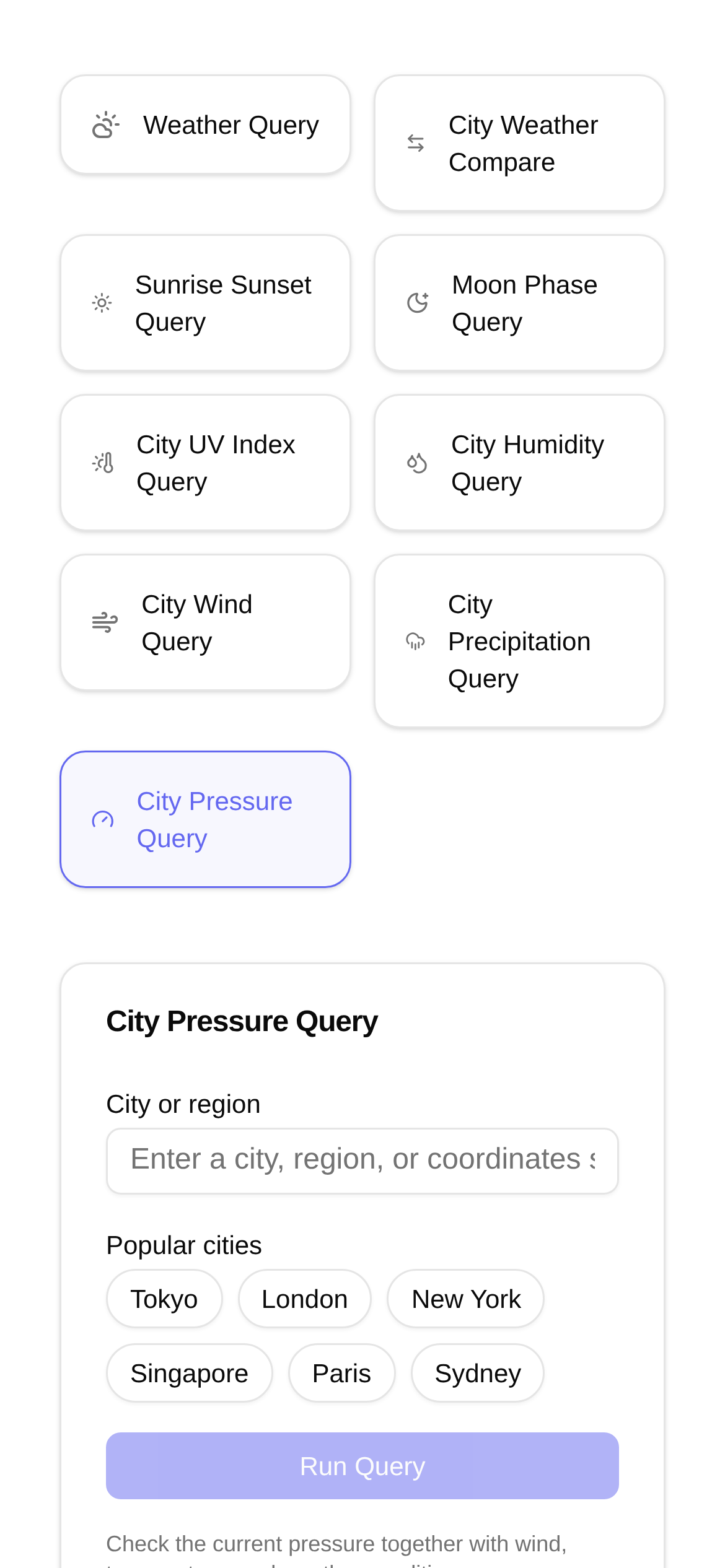
Every time you check the weather forecast, the atmospheric pressure data is often vague and confusing. Especially when preparing for outdoor activities or conducting experiments that require precise data, knowing the exact real-time sea level pressure of a specific location is crucial. Guessing based on feeling will eventually lead to problems. Today, let's discuss how to quickly and accurately check the real-time sea level pressure of major Chinese cities, giving you reliable, first-hand meteorological data.
Why is Sea Level Pressure So Important?
Simply put, sea level pressure is the atmospheric pressure measured at a specific location, "calibrated" to a theoretical sea level based on its altitude and other factors. This isn't just a casual mention in a weather report; it's a hard metric in many professional fields.
- Weather Indicator: Pressure changes are closely linked to weather systems. Generally, high pressure means clear skies and sunny weather, while low pressure can bring continuous rain, strong winds, or even extreme weather. Monitoring real-time sea level pressure helps us better understand and predict weather patterns.
- Aviation and Maritime: Pilots and sailors rely on precise sea level pressure data to calibrate their altimeters and barometers, which is critical for flight and navigation safety.
- Key Laboratory Parameters: In physics and chemistry experiments, atmospheric pressure is a vital environmental factor that must be accurately recorded and controlled.
- Lifeline for Outdoor Explorers: For extreme sports like mountaineering and diving, pressure changes are a matter of life and death. Real-time data helps adventurers anticipate risks and make safer decisions.
The problem is that most everyday weather websites only provide regional pressure trends. Finding real-time, precise data for a specific city can feel like looking for a needle in a haystack. Don't worry, the tool we're introducing today solves this exact pain point.
Who Needs This City Pressure Query Tool?
This online tool, called City Pressure Query, is especially suitable for the following people:
- Meteorology Enthusiasts: Those who want to study regional pressure changes and enhance their weather forecasting skills.
- Outdoor Adventurers: Hikers, climbers, and divers who need to check the real-time pressure of their destination to assess risks beforehand.
- Researchers: Scientists who require precise atmospheric pressure data as environmental parameters for experiments.
- Aviation and Maritime Professionals: Those who need supplementary information to calibrate equipment.
- General Public: Anyone sensitive to weather changes who wants to learn more about meteorological data to plan their trips.
Unlike most vague query methods on the market, this tool is different. Its data comes directly from the National Meteorological Information Center, ensuring high authority and real-time reliability. People often ask "how to accurately check city pressure" or "where to find accurate sea level pressure." This tool is the ultimate solution to these long-tail queries.
How to Use the City Pressure Query to Get Data?
Using the City Pressure Query tool is incredibly simple. You can get it done in just a few steps:
- Open the Tool Page: Enter the URL
https://www.toolkk.com/tools/city-pressure-queryin your browser to access the main interface of the City Pressure Query. - Select a City: Find the city selection box on the page and open the dropdown menu, which lists major Chinese cities. If you have a specific city in mind, you can type its name (e.g., "Beijing", "Shanghai", "Guangzhou") directly into the search box to find it quickly.
- Click Query: After selecting your desired city, click the "Query" button next to it.
- View Results: The page will instantly display the current sea level pressure for that city (usually in hPa or mbar) and may also show the last update time to ensure you are viewing the latest data.
The entire process takes less than 10 seconds—it's fast and convenient! Whether you're on a computer or a smartphone, the operation is smooth, so you'll never have to search for a "city pressure query tutorial" again.
FAQ: What to Know When Using the City Pressure Query
Q1: Why is there sometimes a slight delay in the data? A1: Although the data originates from the National Meteorological Information Center, data transmission and updates can occasionally experience a delay of a few milliseconds. However, for daily use or most professional needs, this delay is negligible, and the data remains highly real-time.
Q2: Can I check the pressure for all cities? A2: Currently, the tool primarily supports provincial capitals, direct-administered municipalities, and major prefecture-level cities in mainland China. If your target city isn't on the list, try using a nearby major city as a reference.
Q3: What is the difference between sea level pressure and actual station pressure? A3: Actual pressure (station pressure) is the value measured directly at your location, which varies significantly with altitude. Sea level pressure, on the other hand, uses a formula to adjust the actual pressure to a universally recognized theoretical sea level value. This "flattens" the impact of altitude, allowing pressure readings from different locations to be accurately compared.
Q4: How does this tool's data differ from the pressure data on weather apps? A4: Weather apps typically provide regional pressure based on predictive models or local sensor readings. The City Pressure Query tool provides calibrated, real-time sea level pressure for specific cities, sourced from the National Meteorological Information Center. This makes it more authoritative and precise, especially for professional scenarios with strict data accuracy requirements.
Q5: Is the City Pressure Query tool free to use? A5: Yes, this tool is currently completely free to use. Its goal is to provide everyone with quick and convenient access to meteorological data.
Now you know how to use the City Pressure Query tool to check the real-time sea level pressure of major Chinese cities. Say goodbye to ambiguous data and embrace precise meteorology to make your life and work more manageable!