

Tool Interface Preview
Random Netherlands Address Generator
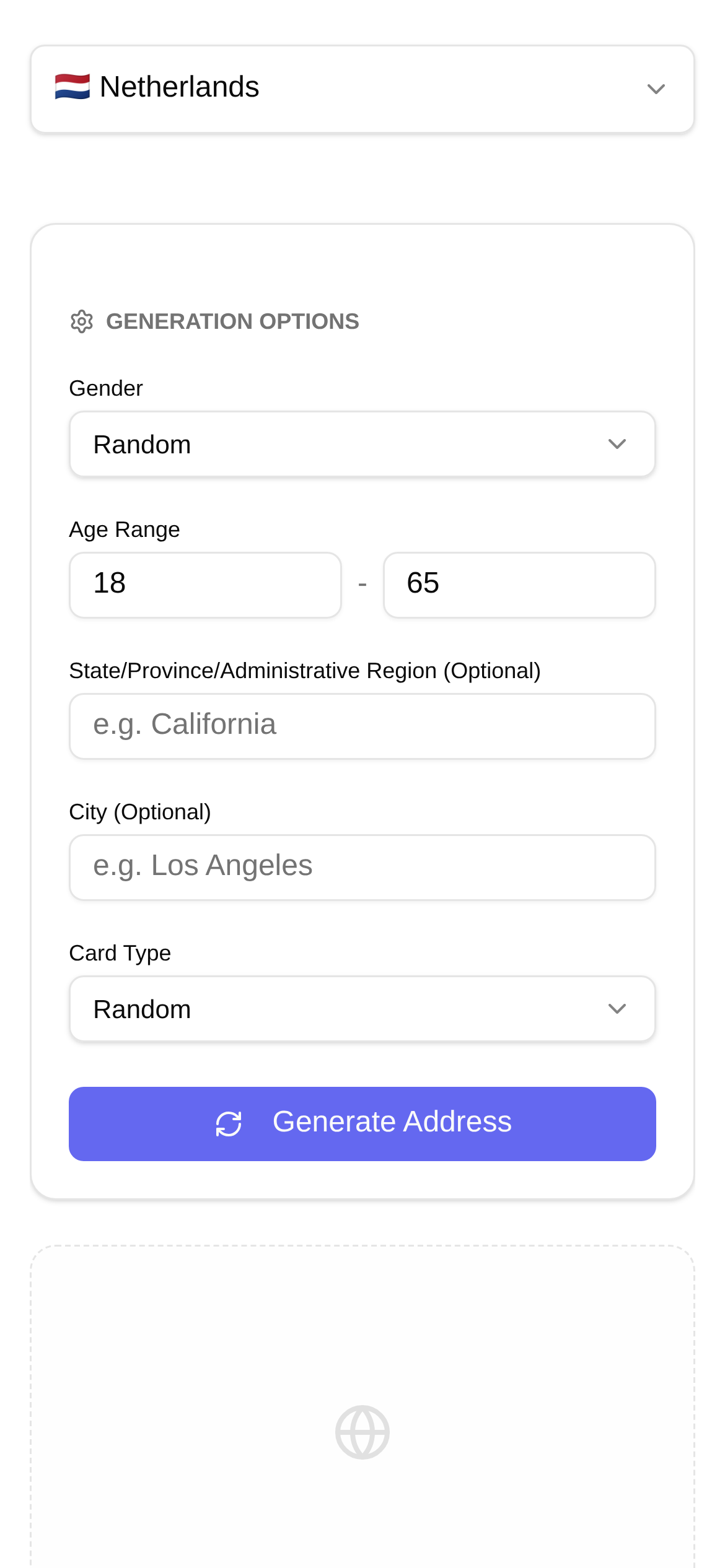
In the daily routine of software development and testing, data is like the bricks and mortar of a building—an indispensable foundation. But then again, manually fabricating test data is maddeningly inefficient; and if you use real user data directly, you have to carefully navigate major privacy and security issues. So, is there a way to quickly and safely generate test data that is both realistic and diverse? Today, let's talk about what generating realistic test data is all about.
Why Do We Need Realistic Test Data?
In the past, we might have just casually typed "John Doe" or "Jane Smith" for testing, or simply looped through numbers. But as you know, real-world data is never that simple, and this approach completely fails to simulate the complexity of real-world scenarios. As a result, you easily run into these headache-inducing problems:
- Insufficient Test Coverage: Many edge cases and bizarre exception scenarios are never touched upon.
- Hidden Bugs Go Unnoticed: Many bugs only surface when the data patterns actually resemble the real world. Testing with fake data keeps these landmines quietly hidden.
- Inaccurate Performance Testing Results: Simple data volumes and structures fail to reflect the true impact of real data on system performance.
- Poor User Experience: If you use a bunch of fake-looking data for demos or internal testing before a feature goes live, even the developers themselves will feel the product quality is lacking.
- Privacy Compliance Troubles: Using production data directly for testing is no joke. You could easily violate data privacy regulations like GDPR and CCPA, leading to financial penalties or, worse, damaging the company's reputation.
Therefore, if you want to take your software quality to the next level and ensure data security, generating realistic test data that is diverse, consistent, representative, and anonymous becomes absolutely crucial.
Key Features of Realistic Test Data Generation
To generate realistic test data, you usually need some solid capabilities. Core features generally include:
- Extremely Rich Data Types: Not only can it generate basics like strings, numbers, dates, booleans, and enums, but it can also simulate more advanced structures like names, addresses, phone numbers, emails, and ID numbers—data we commonly see in our daily lives.
- Strict Data Formatting: The generated data must meet specific formatting requirements, such as the correct number of digits for a zip code or valid phone number formats. No random gibberish allowed.
- Maintained Data Relationships: Think about it: shouldn't there be a relationship between a user ID and an order ID? When generating data across multiple tables or fields, it ensures these logical relationships are perfectly maintained.
- Pseudonymization of Sensitive Info: Personally Identifiable Information (PII) cannot be leaked casually. Therefore, it masks sensitive data to ensure the test data contains absolutely no information that could identify a specific individual.
- Customizable Data Volume: How much data do you want to generate? A few hundred rows or tens of thousands? You can generate exactly as much as your testing needs require.
- Support for Regional Data: Different countries and regions have different address formats and phone number rules. It can generate data tailored to specific geographical locations and local characteristics.
Where Can This Realistic Test Data Be Used?
- Unit and Integration Testing: Providing inputs for every small module of code to see if the functional logic runs smoothly.
- Performance and Load Testing: Simulating a massive amount of users and transaction data to see if the system crashes under high concurrency pressure.
- Security Testing: Intentionally using weird data formats to test if the system's input validation and anti-injection capabilities are strong enough.
- Data Migration and ETL Testing: Verifying that data moved from one system to another remains completely intact and accurate.
- UI/UX Testing: Filling the interface with near-real data to see if there are any awkward layout or interaction issues.
- Demos and Training: Creating a highly realistic demo environment and training data for an immersive experience.
For example, if your app wants to do business globally and support users worldwide, a simple domestic address generator just won't cut it. In this case, you need a tool that can generate address formats for specific countries. For instance, if you are developing an app for the European market and need to simulate address information for Dutch users, a tool like the **Random Netherlands Address Generator** comes in incredibly handy. It helps you generate perfectly formatted virtual Dutch addresses, making it ideal for both development testing and protecting user privacy. Here is the link for anyone who needs it: https://www.toolkk.com/tools/random-netherlands-address-generator
Step-by-Step Guide: Using the Random Netherlands Address Generator
For those wondering "how to use the Netherlands address generator," the operation is actually incredibly simple—basically foolproof:
- Open the Tool Page: Grab your browser and directly visit this URL: https://www.toolkk.com/tools/random-netherlands-address-generator.
- Select the Quantity (if applicable): Some tools let you choose how much data to generate; just fill it in according to your needs.
- Click the "Generate" Button: Usually, there is a highly visible "Generate" button on the page. Click it!
- Copy the Results: The generated Dutch addresses will pop up immediately, and you can just copy and use them.
This tool not only answers the question of "who is the Netherlands address generator for" (answer: any developer or tester needing Dutch address test data), but it also avoids the formatting errors or unrealistic issues that arise when we manually fabricate addresses. Compared to generic data generators, its advantage lies in its professionalism and regional accuracy, ensuring the generated addresses fully comply with actual Dutch address standards.
Frequently Asked Questions and Quick Tips
- Is the generated data actually "real"? Let's put it this way: most data generators produce data that "looks very real." They meet formatting requirements and probability distributions, but they don't correspond to a real person or place in the real world. The goal is to simulate real scenarios, not to perfectly copy real data.
- How do you ensure data consistency? If your data has strong correlations (like a user and their placed orders), relying solely on online tools might not be enough. You might need more professional test data management tools or write small scripts yourself to maintain consistency between data points.
- What if the data volume is massive? If you need to generate terabytes of data, a single online tool definitely won't suffice. In that case, you'll need to consider specialized offline data generation tools or simply write a program to handle it.
- With so many tools, how do I choose the right one? When picking a tool, you need to see if its features are sufficient, if it's easy to use, how its performance is, and most importantly, whether it can meet your specific business needs (e.g., does it support data for a specific region?). For example, if you need to generate a large amount of international address data, a tool that supports multi-country address generation and has an API will definitely have an advantage over one that can only generate a few lines online.
- Don't forget privacy protection: Even when generating fake data, you need to be careful not to accidentally generate data that is highly similar to real personal information, as that carries potential privacy risks.
- How does the "Netherlands Address Generator" compare to other tools? Its main strength is its regional specialization. Generic data generators might not accurately simulate the unique address structures of the Netherlands (like house number suffixes or zip code formats), but a dedicated tool ensures high accuracy and usability.
So, as long as we make good use of various test data generation tools, software testing will become more efficient and comprehensive, and our product quality and user satisfaction will soar. Stop relying on "John Doe" and start embracing realistic, credible test data today!