

Tool Interface Preview
Leap Year Calculator
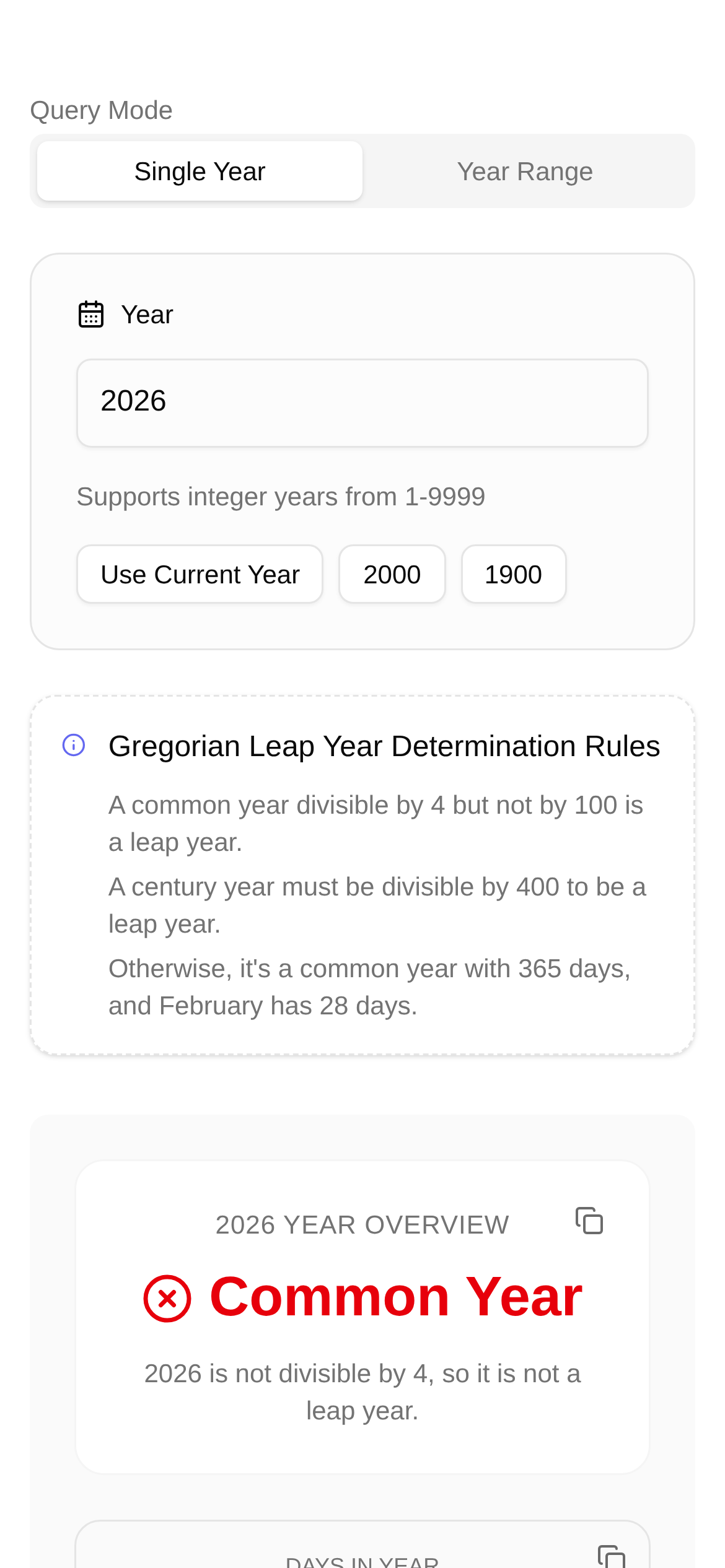
Have you ever wondered why some years have an extra day in February? And why the saying "a leap year every four years" isn't always accurate? In fact, there is an ingenious and somewhat complex set of calendar rules behind this. The calendar we use today is called the Gregorian calendar. Today, we'll talk about leap years and recommend a handy tool to help you completely understand how leap years are calculated.
Where Do Leap Years Come From?
The Earth's orbit around the sun isn't exactly 365 days; it takes about 365 days, 5 hours, 48 minutes, and 46 seconds. To make up for this discrepancy of nearly 6 hours each year, "leap years" were introduced to the calendar. Adding an extra day aligns our calendar year with the Earth's orbital period, ensuring the seasons don't drift over time. The Gregorian calendar is currently the most widely used civil calendar in the world, and its leap year rules are as follows:
- Years divisible by 4 are leap years. This is the most basic condition. For example, 2024 and 2028 are leap years.
- However, years divisible by 100 are not leap years. This acts as a correction. For instance, 1900 and 2100 are not leap years.
- Unless the year is also divisible by 400, in which case it is a leap year. This is the second correction rule. For example, 2000 and 2400 are leap years.
Simply put, the rule is "a leap year every four years, except for years divisible by 100, unless they are also divisible by 400." This set of rules ensures that the calendar closely matches the Earth's orbital period, resulting in exactly 97 leap years every 400 years.
Leap Year Calculator: Your Personal Calendar Assistant
Understanding the rules is one thing, but actually determining leap years—especially when dealing with the special 100-year and 400-year exceptions—can still be a bit confusing. This is where a reliable tool comes in handy! I highly recommend our "Leap Year Calculator" (https://www.toolkk.com/tools/leap-year-calculator).
This handy tool can help you easily solve various leap year problems. Not only can it determine whether a specific year is a leap year, but it can also list all leap years within a specified time range. Whether you want to know if "2024 is a leap year" or check "which years between 1900 and 2100 are leap years," it will quickly give you the accurate answer.
How to Use the Leap Year Calculator: A Step-by-Step Guide
The Leap Year Calculator is incredibly simple to use. Even if it's your first time, you'll get the hang of it effortlessly.
- Open the tool page: Click this link https://www.toolkk.com/tools/leap-year-calculator to access the Leap Year Calculator.
- Check a single year: In the "Check Single Year" box, enter the year you want to check, such as "2024", and click the "Check" button. The tool will instantly tell you that "2024 is a leap year".
- Find leap years in a range: If you want to find all leap years within a specific time period, use the "Find Leap Years in Range" feature. Enter your desired start and end years (e.g., 1900 and 2100) in the "Start Year" and "End Year" boxes, respectively, and click "Search". The tool will quickly list all leap years within that range that follow the Gregorian calendar rules.
Who Needs a Leap Year Calculator? See If It's You
This Leap Year Calculator has a wide range of uses:
- Students: When studying history, geography, or science, you can use it to verify leap year rules and deepen your understanding of calendar knowledge.
- Programmers and Developers: When writing code that involves date calculations, you can use it to verify your leap year logic, preventing data errors caused by incorrect leap year calculations.
- Calendar Enthusiasts: Anyone interested in calendars can use it to study the distribution patterns of leap years across different eras.
- Event Planners: When organizing long-term events spanning multiple years, you need to calculate days precisely to ensure dates are correct.
- General Public: Anyone curious about "February 29" and the scientific principles behind leap years.
Frequently Asked Questions
- Why do we have leap years? As mentioned earlier, leap years exist to make up for the slight discrepancy between the Earth's orbital period and our calendar year, keeping the seasons and the calendar in sync.
- Why does February have 29 days in a leap year? February is the shortest month in the Gregorian calendar. Adding the leap day here minimizes the impact on the dates of other months, keeping the overall calendar relatively stable.
- How far back or forward can this tool check? Our Leap Year Calculator is designed based on the Gregorian calendar rules and can theoretically evaluate any year that follows these rules. However, the Gregorian calendar was only introduced in 1582; for years prior to this, leap year rules may differ.
- What makes this tool different from other leap year calculators? Our tool features a clean interface and is easy to use. It focuses on accurately applying Gregorian calendar rules for single-year checks and range queries without unnecessary bells and whistles, making it highly efficient and user-friendly.
After reading this article and trying out the Leap Year Calculator, you should have a crystal-clear understanding of leap years. The next time February 29 rolls around, you can confidently explain the science behind it to your friends!
Disclaimer: This article is primarily intended to explain leap year knowledge and introduce how to use the tool; it does not constitute professional advice. If you are making important decisions or conducting in-depth research, please consult authoritative calendar resources.