

Tool Interface Preview
Index of Coincidence Calculator
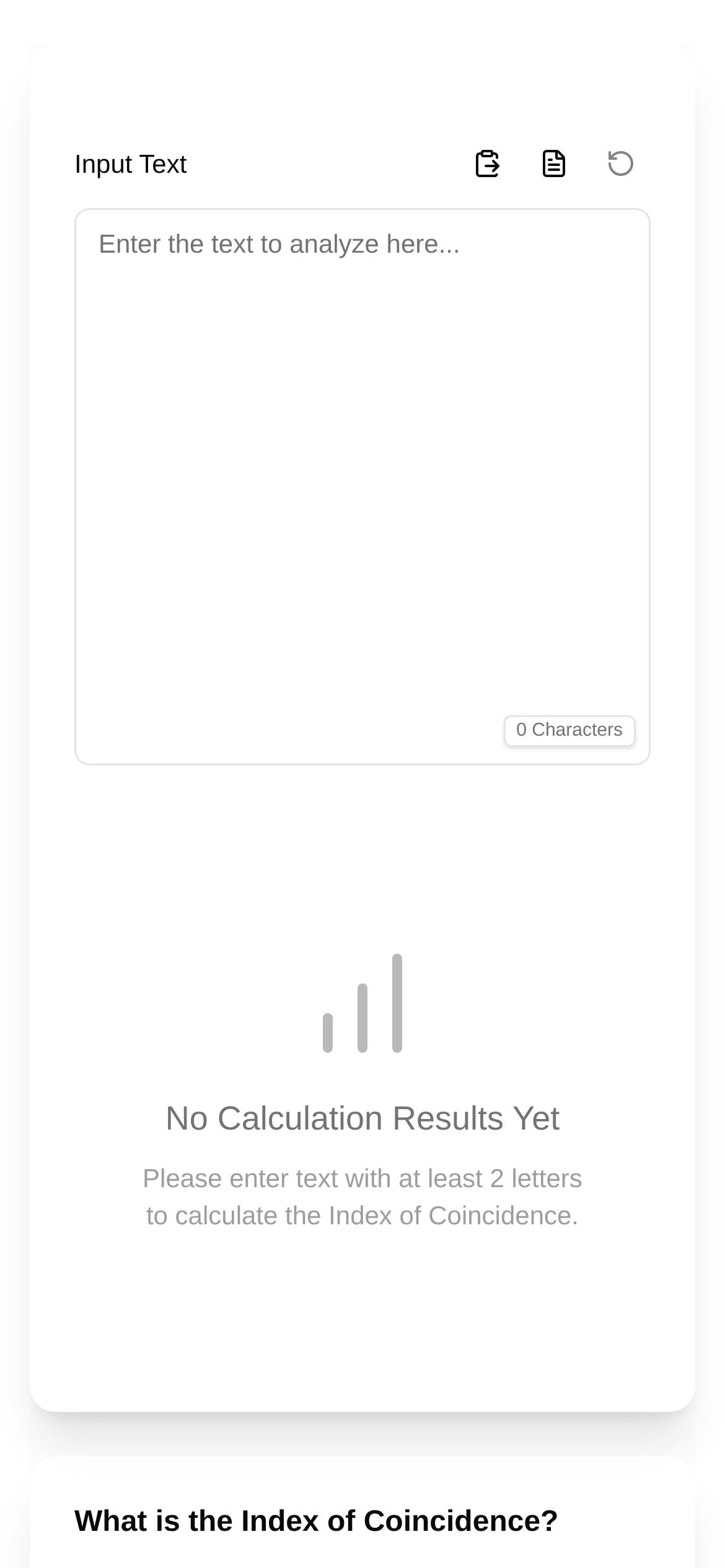
Hey everyone! Today, I want to talk about a fascinating concept in cryptography—the Index of Coincidence (IC). It's an incredibly handy tool for cryptanalysis, especially now that there are online calculators making it super easy to use. In this post, I'll break down exactly what the IC is, what it can do, and then walk you through how to use the tool step-by-step.
What Exactly is the Index of Coincidence (IC)?
Simply put, the Index of Coincidence measures the probability that two randomly selected letters from a piece of text will be identical. Sounds a bit confusing? It's basically a way to see how "evenly" letters are distributed in a text. Take English, for example: letters like E, T, A, and O appear very frequently, so standard English has a relatively high and stable IC value. However, if a ciphertext is well-encrypted, every letter should appear with roughly the same frequency, resulting in a much lower IC value that approaches complete randomness.
Why is the IC so important for cryptanalysis?
The IC value is a crucial clue for determining whether a ciphertext uses a polyalphabetic substitution cipher (like the Vigenère cipher). If the ciphertext's IC value is close to that of a natural language (like English), it's likely a monoalphabetic substitution cipher (like the Caesar cipher) or perhaps not encrypted at all. But if the IC value is low enough to approach a random distribution, it's highly likely a polyalphabetic substitution cipher or an even more complex encryption method. Even better, by calculating the IC values of different groupings of the ciphertext, we can guess the key length of a Vigenère cipher, which is a major breakthrough in cryptanalysis!
IC Calculator: A Great Helper for Cryptanalysis
Back in the day, calculating the IC value meant counting letters one by one—it was exhausting and prone to errors. Now, various online tools have sprung up, helping you get it done in minutes. Today, I want to highly recommend a fantastic tool: the Index of Coincidence Calculator.
This **Index of Coincidence Calculator** (toolkk.com/tools/index-of-coincidence-calculator) is incredibly user-friendly. Not only does it calculate the IC value of a text, but it also tallies English letter frequencies, which is extremely useful for both cryptanalysis and language identification. If you're wondering "how to use the index of coincidence" or looking for an "index of coincidence calculation tutorial," you definitely shouldn't miss this tool.
Who would use an IC Calculator?
- Cryptography enthusiasts or students: Learning classical cryptanalysis and wanting hands-on experience with how the IC helps crack the Vigenère cipher.
- Information security researchers: Needing assistance in analyzing whether an unknown ciphertext is securely encrypted and identifying its cipher type.
- Linguists: Wanting to analyze the characteristics of letter frequency distributions across different languages.
- Teachers: Using it as an educational tool to demonstrate the principles of letter frequency and cryptanalysis to students.
How to use this IC Calculator?
Using the Index of Coincidence Calculator (toolkk.com/tools/index-of-coincidence-calculator) is a piece of cake. Here is a detailed step-by-step guide:
- Open the tool: Type https://www.toolkk.com/tools/index-of-coincidence-calculator into your browser to access the calculator page directly.
- Paste your text: Copy and paste the English text you want to analyze (either plaintext or ciphertext) directly into the input box on the page. Keep in mind that this tool currently focuses on analyzing English letters, as other languages have different letter frequency distributions.
- Click "Calculate": Find the "Calculate" or "Analyze" button on the page and click it. The tool will immediately start processing your text.
- View the results: The results area will display the calculated IC value, usually accompanied by a frequency chart or list for each letter. You can compare this IC value with the standard English IC (about 0.067) and the random English IC (about 0.0385) to roughly determine the encryption status of the text.
Pro Tip: If you are analyzing a Vigenère cipher, try grouping the ciphertext by different key lengths (specifically, pick out every Nth letter to form a sub-ciphertext) and calculate the IC value for each sub-ciphertext. When a sub-ciphertext's IC value closely matches the natural English IC value, that N is very likely the true length of the key. This is the core concept of the "Index of Coincidence Method" and answers the question for those wondering "who is the IC calculator for"—anyone needing to perform this type of analysis.
Frequently Asked Questions and Important Notes
- How does this "Index of Coincidence Calculator compare" to other tools? What are its advantages? Personally, I find the interface very clean and intuitive. It also tallies letter frequencies on the side, making it exceptionally friendly for beginners or anyone looking for a quick analysis. While some professional tools might be more complex, this one is more than enough for everyday learning and practicing cryptanalysis.
- What if the IC value seems inaccurate? Text length significantly impacts the accuracy of the IC value. The shorter the text, the more susceptible the IC value is to randomness, which can make it less accurate. It is recommended to use longer texts for analysis to get more reliable results.
- Does this tool support Chinese? Currently, it is primarily designed for English letter frequency statistics and IC calculation. The statistical methods and IC concepts for Chinese are quite different from English, so this tool is not applicable for it at the moment.
- What are the "Index of Coincidence precautions"? The IC value is just an auxiliary tool for cryptanalysis. You cannot rely solely on it to determine the encryption type or crack a cipher. It usually needs to be used in conjunction with other analytical techniques (like the Kasiski examination, frequency analysis, etc.) to be fully effective.
Having covered all this today, I believe you now have a deeper understanding of the Index of Coincidence (IC) and know how to use the Index of Coincidence Calculator (toolkk.com/tools/index-of-coincidence-calculator) online tool for cryptanalysis. I hope this "Index of Coincidence tutorial" helps you take another step forward in your cryptography studies and practice!
Disclaimer: The content of this tutorial is strictly for educational and reference purposes. Please do not use it for any illegal activities. Knowledge in the field of information security updates rapidly, so always stay tuned to the latest developments. Cryptanalysis is a complex process; this tool only provides auxiliary functions and cannot replace professional cryptographic research and practice.