

Tool Interface Preview
Bazi to Solar Calendar Converter
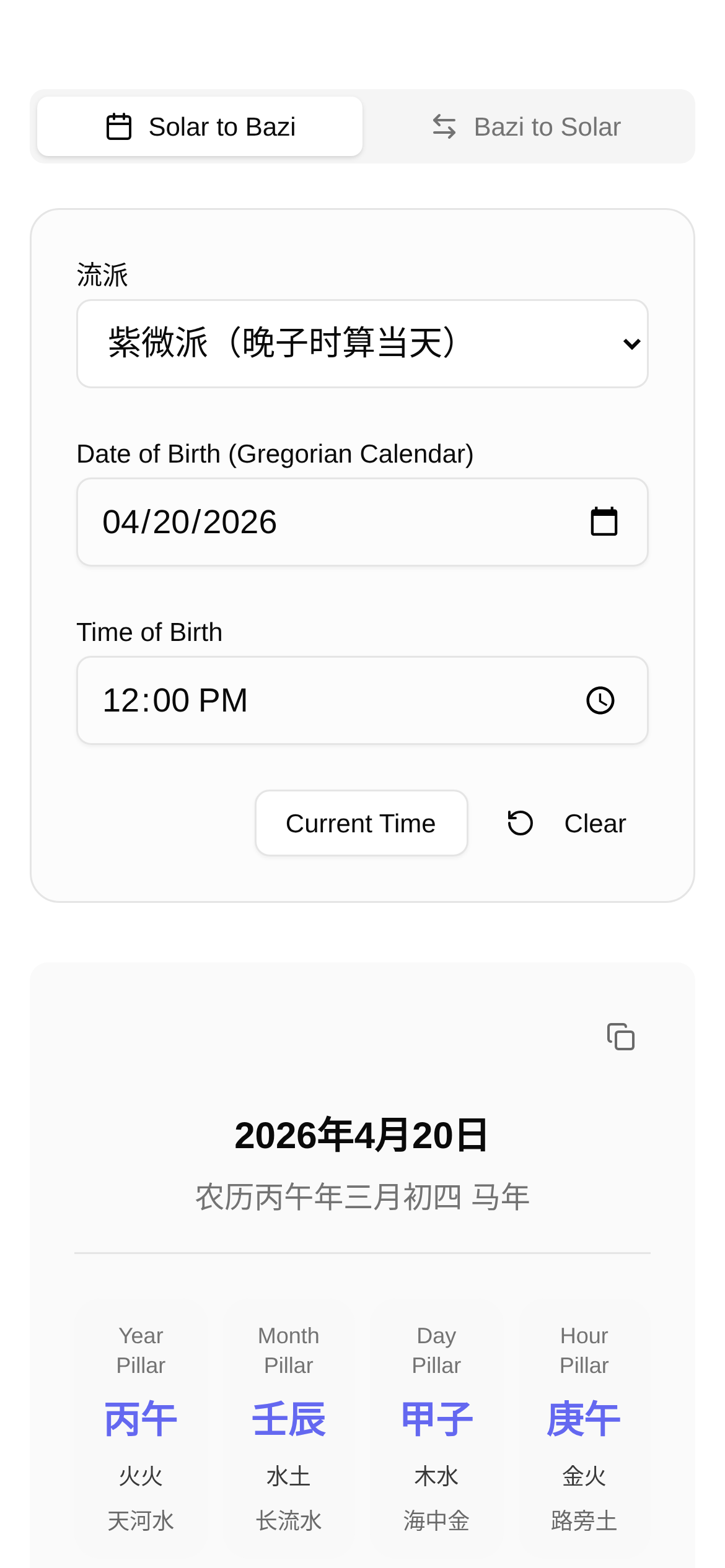
In the profound study of Bazi (Four Pillars of Destiny), accurately determining the birth hour is like setting the anchor for the entire destiny chart; its precision directly affects the accuracy of the whole reading. Especially for those born around midnight, known as the "Zi Hour" (子时), distinguishing between the "Early Zi Hour" and "Late Zi Hour" often confuses many astrology enthusiasts and even beginners. Today, we will discuss how to calculate the Late Zi Hour (also known as Night Zi Hour) in Bazi and introduce a highly useful tool to help you easily solve this headache.
How Important is the Late Zi Hour (Night Zi Hour) in Bazi Calculations?
The Zi Hour spans from 11:00 PM to 1:00 AM. In traditional Chinese astrology, it is subdivided into the "Early Zi Hour" and the "Late Zi Hour" (or "Night Zi Hour"). Generally, the Late Zi Hour refers to the period from midnight (12:00 AM) to 1:00 AM. Many astrological schools believe that if you are born during the Late Zi Hour, your Day Pillar (日柱) should be calculated as the following day rather than the actual day of birth. This rule stems from the ancients' understanding of the day-night transition and the starting point of the Sexagenary cycle (Stem-Branch) for recording days.
Think about it: if the Late Zi Hour is not handled correctly, the Day Pillar, Hour Pillar, and potentially even the Year Pillar could be wrong. This is no small matter. The analysis of the entire destiny chart—such as your personality, fortune, marriage, and career—could be completely skewed. Therefore, understanding how to calculate the Late Zi Hour and using the correct method is absolutely critical for the accuracy of Bazi charting.
Who Needs to Pay Special Attention to the Late Zi Hour Pitfall When Charting Bazi?
- People born around midnight (especially between 11:00 PM and 1:00 AM): This group is the most directly affected. Whether you are charting for yourself or your friends and family, you must pay extra attention and double-check.
- Astrology students and researchers: Deeply understanding how different schools handle the Zi Hour is key to taking your skills to the next level.
- People who demand high accuracy in Bazi: Even a slight error in the birth hour can lead to vastly different astrological results. It is better to be meticulous and rigorous than careless.
- Users of traditional perpetual calendars or charting software who find discrepancies: In these cases, it is highly likely that different schools of Zi Hour processing are at play.
Don't Panic! Easily Handle the Late Zi Hour with the "Bazi to Solar Calendar Converter" Tool
Faced with the complex issue of the Late Zi Hour, calculating it manually carries a high risk of error. This is where a handy tool can be of great help. I highly recommend trying this online tool called the **"Bazi to Solar Calendar Converter"**. The link is right here: https://www.toolkk.com/tools/horoscope-solar-converter.
This tool doesn't just convert between Bazi and Gregorian (solar) calendar dates. Even better, it features a **"Zi Hour Processing School Selection"** function, which is tailor-made for Late Zi Hour charting and perfectly solves this headache.
It's not difficult to use at all. Let me walk you through it step by step:
-
Open the tool page: Simply click the link above to access the "Bazi to Solar Calendar Converter" tool page.
-
Enter your birth date and time: Fill in your Gregorian birth year, month, day, hour, and minute in the corresponding fields. For example, if you were born at 12:30 AM on January 1, 1990, enter it exactly like that.
-
Select the "Zi Hour Processing School": This is the most crucial step. The tool typically provides several options, such as:
- "Zi Hour belongs to the current day": This means the entire period from 11:00 PM to 1:00 AM is counted as the day of birth.
- "Early Zi Hour belongs to the current day, Late Zi Hour belongs to the next day": This is what we are focusing on today. It generally means 11:00 PM to 12:00 AM is counted as the current day, while 12:00 AM to 1:00 AM is counted as the next day.
- "Zi Hour uniformly belongs to the next day": This school is less common and counts the entire 11:00 PM to 1:00 AM period as the next day.
- "Process according to True Solar Time": This method is more accurate, as it calibrates the time based on the longitude of your birthplace.
For the Late Zi Hour (Night Zi Hour) issue, it is best to select "Early Zi Hour belongs to the current day, Late Zi Hour belongs to the next day." If you want even higher precision, choose "Process according to True Solar Time."
-
Click the "Convert" or "Chart" button: The tool will automatically calculate the corresponding Bazi Stem-Branch based on your selections.
-
Carefully verify the results: Especially for those born around midnight, be sure to closely examine the Day Pillar and Hour Pillar provided by the tool and compare the differences between various schools.
Why Everyone Loves the "Bazi to Solar Calendar Converter" Tool and Its Advantages
This tool is particularly suitable for the following people:
- Bazi beginners: Helps you avoid charting errors caused by a lack of theoretical knowledge.
- Experienced astrologers: Serves as a great auxiliary verification tool to improve your work efficiency and accuracy.
- People who require time precision: By using True Solar Time processing, you can obtain Bazi information that is closer to reality.
It has many advantages:
- Simple operation: The interface is intuitive, and conversion takes just a few steps.
- Multiple schools: Covers mainstream Zi Hour processing methods to meet your various needs.
- Free and online: Available anytime, anywhere, with no downloads or installations required.
- Two-way conversion: Not only converts Gregorian to Bazi, but also Bazi to Gregorian, making it easy for you to cross-check.
Frequently Asked Questions and Quick Reminders
Q1: Why do some charting software lack the "Late Zi Hour belongs to the next day" option?
A1: This may be related to the default school used by that software. Some software might default to counting the entire 11:00 PM to 1:00 AM period as the current day's Zi Hour, or they might only provide True Solar Time calibration. If you encounter this situation, I recommend using a tool like the "Bazi to Solar Calendar Converter," which offers clear Zi Hour school selections, to double-check.
Q2: What is the relationship between True Solar Time and the Late Zi Hour schools?
A2: True Solar Time calibrates standard time (e.g., Beijing Time) to the actual local time based on the longitude of your birthplace. Under True Solar Time, the start and end points of the Zi Hour might shift slightly, which naturally affects the definition of the Late Zi Hour. Therefore, combining True Solar Time with Late Zi Hour processing can make your charting results much more accurate.
Q3: What if the birth certificate only has the date and no specific time?
A3: This is a very common challenge in Bazi charting. In such cases, you usually need to deduce an approximate hour by combining family memories, local customs (such as the time the rooster crows), and feedback on the person's later life fortune. However, once an approximate hour is determined, the issue of the Late Zi Hour still needs attention.
Q4: Is it reliable to use online tools for charting?
A4: As long as the online tool is professionally designed and verified, its calculation logic is sound. The "Bazi to Solar Calendar Converter" is one such rigorously developed tool that you can use with confidence.
Friendly Reminder: Bazi numerology is only for reference and cannot replace professional life planning, medical, legal, or financial advice. When making any important decisions, please be sure to consult professionals in the relevant fields.
We hope this sharing helps you better understand and handle the Late Zi Hour issue in Bazi, making your Bazi charting more accurate and reliable!