

Tool Interface Preview
Norway Address Generator
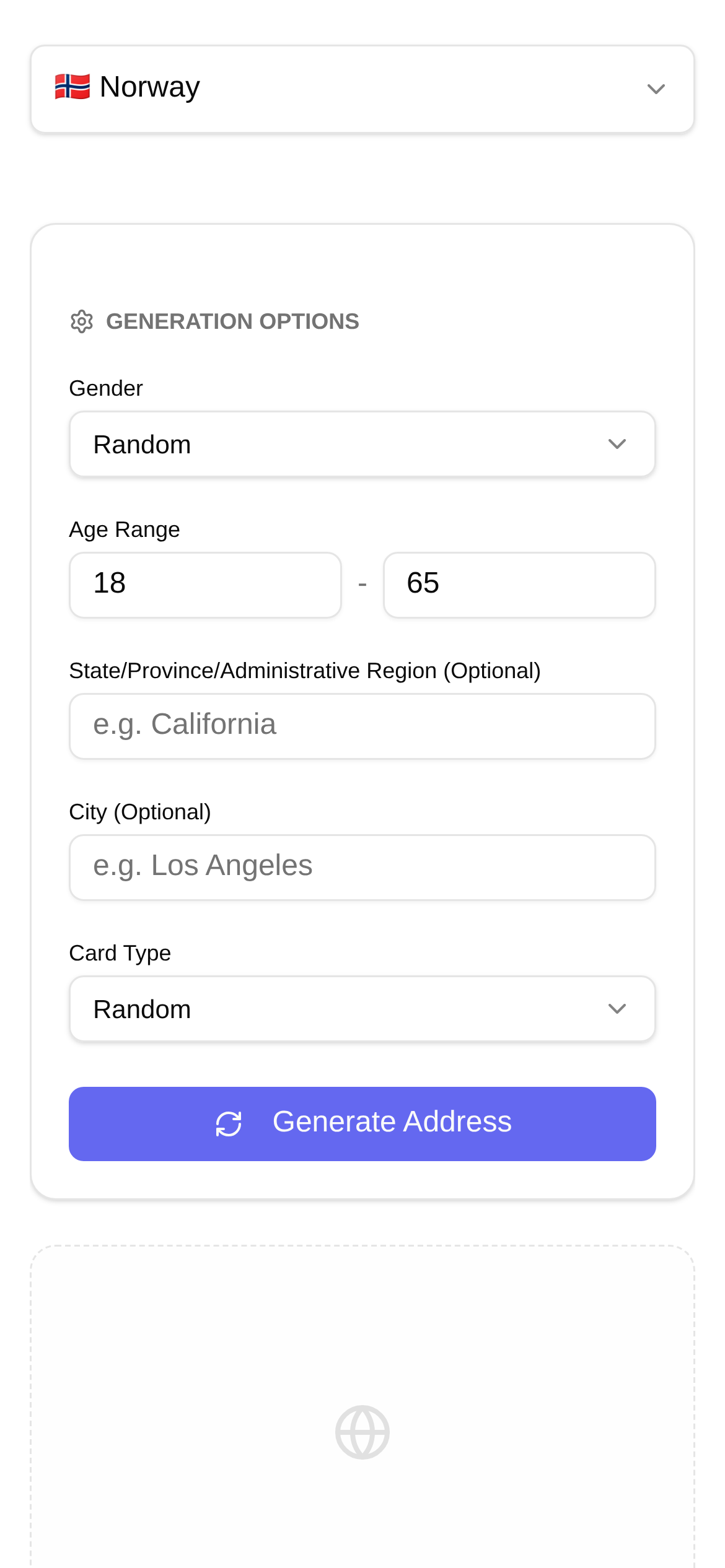
Hey, have you ever wondered how Norway's postal codes actually work? To be honest, for those of us in cross-border e-commerce, data analysis, or software development, this is no small matter. It's not just about whether your package can be successfully delivered to someone in Northern Europe; it's a crucial data point in geographic information systems (GIS), logistics planning, and even market research. Today, we're going to dive deep into the secrets of Norway postal codes and recommend a super handy tool along the way.
What Exactly is a Norway Postal Code?
Norway's postal code, locally known as "Postnummer," consists of just four digits. Sounds pretty simple, right? Unlike the five- or nine-digit ZIP codes in the US, the Norwegian postal service (Posten Norge) manages this system, and it feels quite straightforward to use. But these four digits aren't arranged randomly; they hold the secrets of geographical regions:
- First digit: Usually refers to a large region in Norway, or you can think of it as a major geographical area.
- Second digit: Breaks it down further, generally linked to a specific city or a relatively large regional center.
- Third and fourth digits: These two are much more specific, pinpointing down to a street, a neighborhood, or even a single building.
This hierarchical structure makes postal codes play a core role in Norway's logistics, positioning, and demographic analysis. It ensures your shipments arrive on time and provides data support for various location-based services.
Who Uses Norway Postal Codes?
- Cross-border e-commerce sellers: When processing Norwegian orders, getting one digit wrong in the address can mess things up. An accurate postal code is key to successful delivery; otherwise, the package might get stuck in transit or even returned.
- Software developers / QA engineers: If you're building an app that requires Norwegian addresses, you definitely need test data. Entering them manually one by one is not only inefficient but also prone to errors.
- Data analysts: When conducting market research or geographic information analysis, postal codes are an essential geographical dimension. Through them, you can uncover insights like regional economic status and population distribution.
- Privacy-conscious users: Sometimes, for privacy reasons, you need a realistic-looking Norwegian address that isn't tied to real personal information.
- People interested in Norwegian culture and geography: Understanding postal codes can give you a more intuitive grasp of Norway's geographical layout.
How to Get and Use a Norway Address?
If you need to quickly generate an address that complies with Norwegian postal code rules, or if you need a bunch of mock data for development and testing, making them up manually is definitely not a good idea. This is where a handy tool becomes especially important.
Here, I highly recommend a very useful tool—the Norway Address Generator. It helps you easily generate virtual addresses that match the Norwegian address format, including postal codes, cities, streets, and more. It's incredibly convenient.
So, how do you use the Norway Address Generator?
- Click the link: Just click right here: Norway Address Generator.
- Generate with one click: Once inside, you'll see a very clean interface. Usually, you just need to click a button (like "Generate Address"). The tool will instantly pop out a virtual address containing detailed information like a Norwegian postal code, city, and street.
- Copy and paste: The generated results are displayed clearly. You can directly copy this information and use it for your development testing, data entry, or whatever you need.
Not only is this tool highly efficient, but the generated addresses also comply with real Norwegian format standards, saving you a ton of time on manual creation and validation. For those looking for a "Norway Address Generator tutorial," the operation is just that simple—virtually no learning curve required.
Frequently Asked Questions
Q1: Are the addresses generated by this tool real? A1: No, they are not real addresses; the tool generates virtual addresses. However, these addresses strictly follow Norwegian address formats and postal code rules. In other words, they look real but do not actually correspond to a specific location or person in the real world. This is particularly useful for development testing and privacy protection, avoiding the potential troubles of using real personal information.
Q2: Can I use the generated addresses to send mail? A2: No, absolutely not. Because these addresses are virtual, if you actually send mail to them, it definitely won't be delivered. The purpose of this tool is to provide correctly formatted placeholder addresses, not for you to use for shipping items.
Q3: How are Norway postal codes different from other countries? A3: Norway's four-digit postal codes are relatively concise, unlike the five- or nine-digit ZIP codes in the US, or the alphanumeric mix used in the UK. It focuses more on regional zoning, making it easy to understand and manage. So, if you need to understand or use this concise coding system, this "Norway Address Generator" is perfect for you.
Q4: What should I keep in mind when using this tool? A4: Mainly, be clear about its purpose. It is meant for testing, data population, and privacy protection. Don't expect to use it to obtain real personal information or to send mail. Please, do not use it for any illegal or unethical activities.
Now that you have a deeper understanding of the ins and outs of Norway postal codes, paired with a practical tool like the Norway Address Generator, I'm confident you'll be able to do twice the work with half the effort when handling tasks related to Norwegian addresses!
Quick Tip: This article is purely for educational purposes and tool introduction; it does not constitute any legal, financial, or business advice. How you use it depends entirely on your own needs. For the most reliable information, consult a professional or refer to official documentation.