

Tool Interface Preview
Hexagon Area Calculator
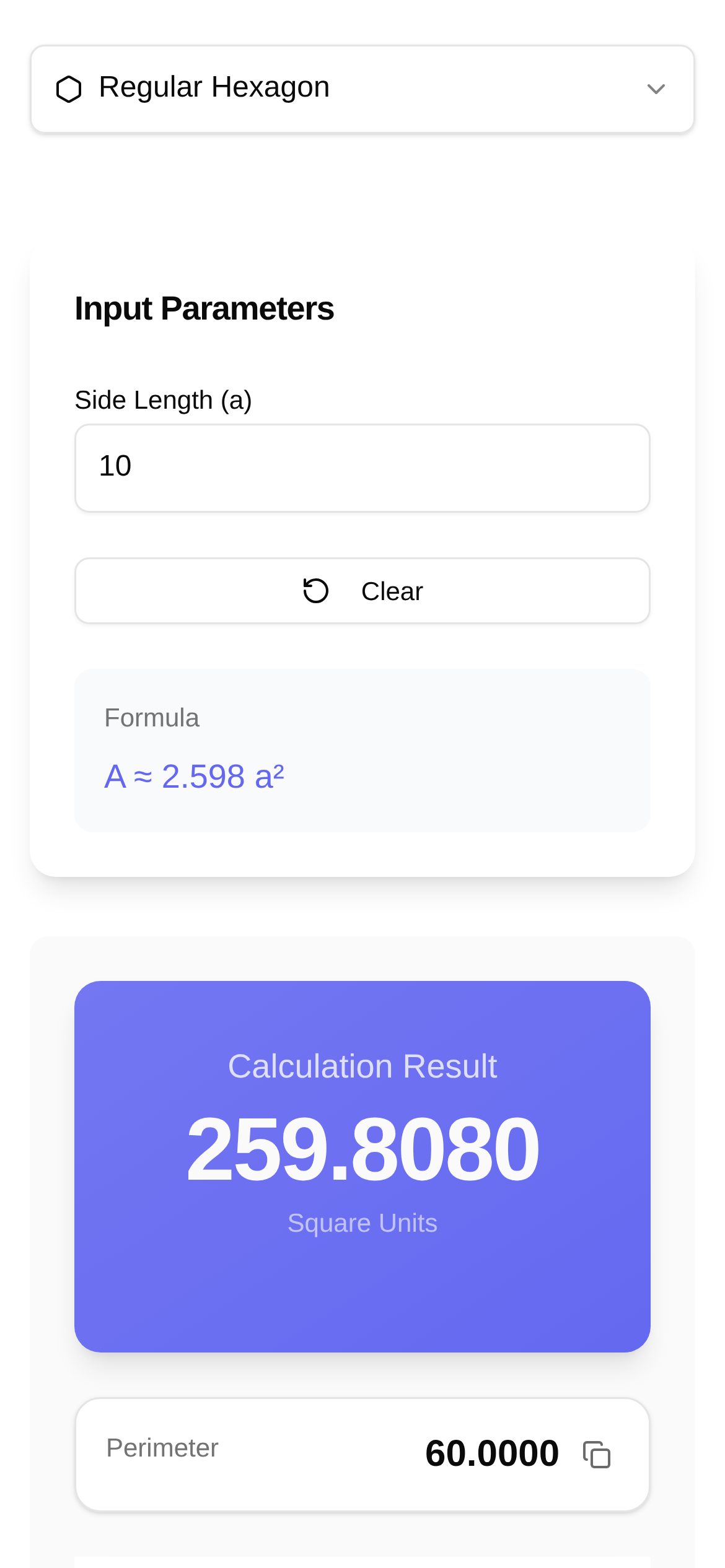
Hey everyone! Today, let's talk about calculating the area of a regular hexagon. This shape is actually everywhere around us. Think about honeycombs, snowflakes, or even the cross-sections of certain screws—they all share this shape, right? Not only is it visually pleasing and structurally stable, but calculating its area is also something we frequently encounter. So today, I'll walk you through exactly how to calculate the area of a regular hexagon step-by-step, and I'll also share a super handy online tool.
How Do You Calculate the Area of a Regular Hexagon?
As the name suggests, a regular hexagon has six equal sides and six equal interior angles. A fantastic characteristic of this shape is that it can be perfectly divided into six identical equilateral triangles. Once you understand this, you're halfway to calculating its area.
Here is the core formula:
If we know the side length of the regular hexagon is a, then the side length of each equilateral triangle inside it is also a. The area of an equilateral triangle with side length a is (√3 / 4) * a². Therefore, the total area A of the regular hexagon is the sum of the areas of these six smaller triangles:
A = 6 * (√3 / 4) * a² = (3√3 / 2) * a²
Simple, right? Memorize this formula, and you'll be able to calculate the area of any regular hexagon in no time.
Who Needs a Hexagon Area Calculator?
You might think this calculation is just for textbooks, but it's actually quite practical in many fields:
- Construction and Engineering: For example, when designing honeycomb panels or laying floor and wall tiles, many custom tiles are hexagonal. You need to calculate the area accurately to know how much material to buy.
- Physics and Chemistry Research: Crystal structures and molecular models like benzene rings frequently feature hexagonal units, making area calculation a fundamental skill.
- Students: In geometry classes, calculating the area of a regular hexagon is a mandatory topic you can't avoid.
- Game Development: Some strategy games or simulation environments use hexagonal grid maps, making area calculation a basic requirement.
- DIY Projects: Whether you're sewing hexagonal quilts or making hexagonal crafts, you need to calculate the area before cutting your materials.
How to Calculate Quickly Using Formulas and Tools?
Now that we know the formula, we can certainly calculate it manually. But if you want to save time or quickly verify your results, is there an easier way? Absolutely! I highly recommend a super handy online tool: the Hexagon Area Calculator.
Manual Calculation, Step-by-Step:
- Measure the side length
a: This is the most crucial step; make sure your measurement is accurate. - Apply the formula: Substitute your measured
avalue into the formulaA = (3√3 / 2) * a². - Calculate the result: Grab a calculator or do the math by hand. Don't forget that
√3is approximately1.732.
Using an Online Tool for Convenience:
- Open the webpage: Enter https://www.toolkk.com/tools/hexagon-area-calculator in your browser and hit enter.
- Enter the side length: You will see a dedicated input box for the side length of the regular hexagon on the page. Enter your value there.
- Click calculate: After entering the side length, click the "Calculate" button.
- View the result: Instantly, the precise area value will appear before your eyes. This Hexagon Area Calculator is incredibly user-friendly and accepts various numerical inputs, saving you the hassle of manual calculations for both studies and engineering projects.
Frequently Asked Questions About Hexagon Area Calculation:
-
Q1: How exactly do I use this hexagon area calculator? A1: It's super simple! Just open the link, enter the side length of the regular hexagon into the input box, and click "Calculate." It will automatically handle the complex formula for you.
-
Q2: Who is this tool suitable for? A2: Students, engineers, designers, or anyone who needs to quickly and accurately calculate the area of a regular hexagon. It significantly boosts efficiency, especially if you need to perform multiple calculations or require high precision.
-
Q3: What are the advantages of using the tool over manual calculation? A3: There are plenty of advantages! It's fast, accurate, and less prone to errors. Manual calculation requires memorizing formulas and calculating square roots, which can easily lead to mistakes. The tool eliminates these hassles and delivers instant results.
-
Q4: Can I use data other than the side length to calculate the area of a regular hexagon? A4: Theoretically, yes. For example, if you know the inradius
ror the circumradiusRof the regular hexagon, you can deduce the area. We know thatr = (√3 / 2) * aandR = a. So, givenrorR, you can first calculate the side lengthaand then apply the area formula. However, the Hexagon Area Calculator we introduced today primarily calculates directly using the side length, as this is the most common and intuitive method. -
Q5: Is there anything I should pay attention to when using this tool? A5: The most important thing is to ensure the side length value you enter is accurate. The tool itself is flawless, but if you input the wrong number, the result will naturally be incorrect. Also, since it's an online tool, you'll need an internet connection to use it.
I hope this guide helps everyone gain a deeper understanding of regular hexagon areas and makes your calculations smoother. The next time you encounter this type of problem, be sure to try the Hexagon Area Calculator I recommended. It's guaranteed to make your calculations a breeze!