

Tool Interface Preview
Child Height Predictor Calculator
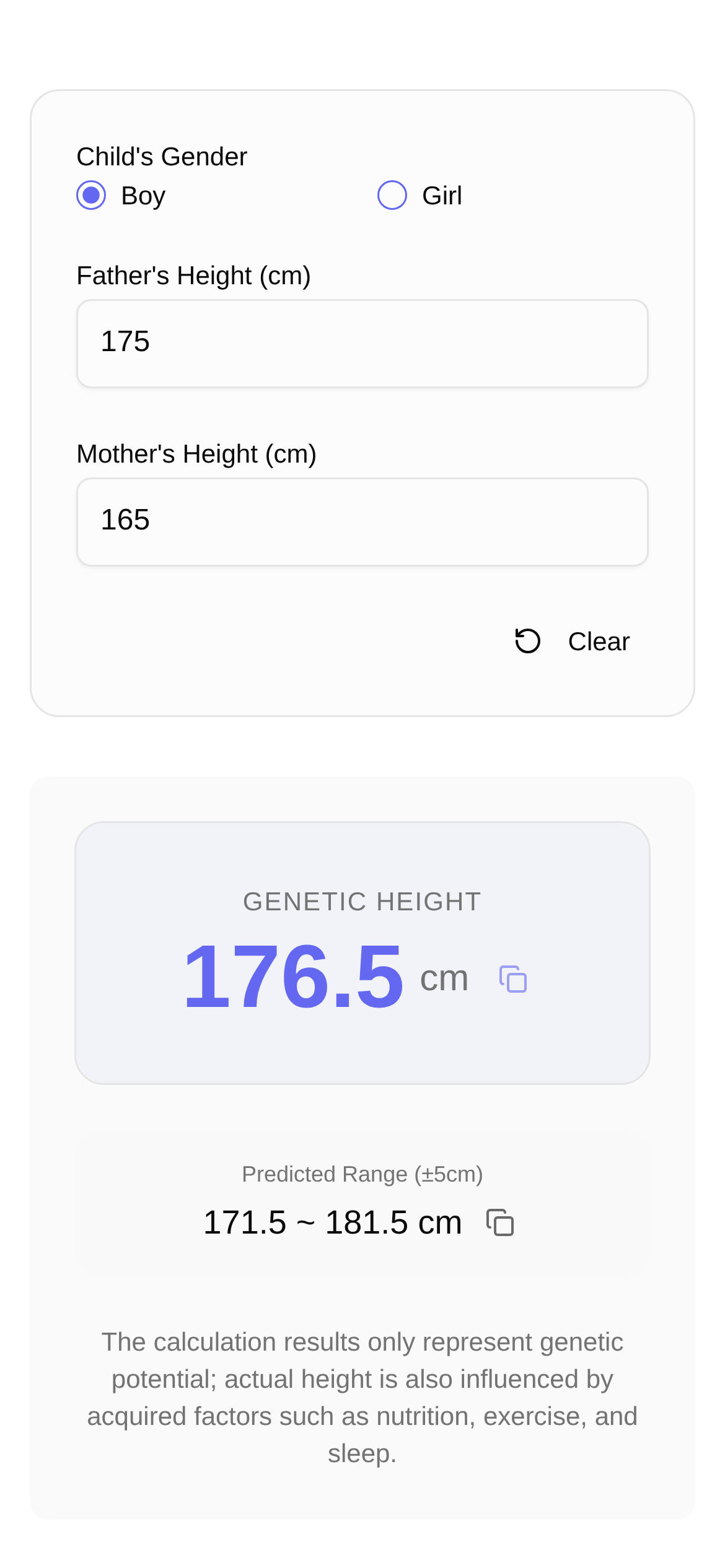
As parents, who doesn't want their kids to grow up tall, strong, healthy, and active? When it comes to height, it's one of the things we care about most. We can't help but wonder: how tall will my child grow up to be? Are the various height prediction methods on the market, especially those calculators claiming to calculate genetic height, actually reliable? Today, let's have an open discussion about height prediction based on genetics, and along the way, recommend a handy online tool—the Child Height Predictor Calculator.
What Exactly Does a Genetic Height Calculator Do?
There's an old saying that "the apple doesn't fall far from the tree," which clearly shows the power of genetics. Height is not determined by a single gene, but is the result of many genes working together. Therefore, the height of the parents has a very real impact on the child. A genetic height calculator leverages this scientific principle. By taking the average height of you and your partner, combined with the child's gender, it roughly estimates the potential height range of your child in adulthood.
However, this tool doesn't give you a "set in stone" number accurate to the centimeter; it provides a **"predicted range."** After all, genetics is complex, and various acquired factors can also introduce significant variables. So, just treat it as a reference and don't take it too literally. It helps you get a general idea of your child's growth potential, allowing you to pay more targeted attention to acquired factors like nutrition, exercise, and sleep, thereby creating a better environment for your child's growth.
Who Can Benefit from This Height Predictor Calculator?
I believe this tool is mainly suitable for the following situations and groups of people:
- New parents: Highly curious about their child's future height and want a rough estimate in advance.
- Experienced parents who care about their child's growth: Looking for a scientific basis to serve as a reference for their child's healthy development.
- Couples planning to have a baby: Just for fun, to see the genetic height potential of their future baby.
- Friends interested in height genetics: Want to understand the basic laws and calculation methods of height genetics.
If you are a parent who wants a preliminary idea of your child's height but doesn't want to get anxious over it, then this tool is quite suitable for you. Remember, it's just a prediction tool and cannot replace a doctor's diagnosis.
How Do You Use This Height Predictor Calculator?
Let's take the Child Height Predictor Calculator as an example, and I'll walk you through exactly how to use it step-by-step:
- Open the webpage: First, type this URL into your browser: https://www.toolkk.com/tools/child-height-calculator, and you will enter the "Child Height Predictor Calculator" page.
- Enter the father's height: Find the corresponding box and enter the father's height (in centimeters).
- Enter the mother's height: Similarly, fill in the mother's height (in centimeters).
- Select the child's gender: Click "Boy" or "Girl" based on the child's actual gender. This step is crucial because the growth curves and genetic height formulas differ slightly for boys and girls.
- Click "Calculate": Once all the information is filled in, simply click the "Calculate" button on the page.
- View the results: The system will immediately tell you the approximate height range of your child in adulthood, usually providing an average value along with a fluctuation range above and below it.
The whole process is incredibly simple, and even if it's your first time using it, you can easily figure it out. Now, is the question of "how to use the child height predictor calculator" crystal clear?
Frequently Asked Questions and Quick Tips
1. Is the genetic height calculator accurate? What is the principle behind it?
The genetic height calculator actually uses a very common genetic formula, usually based on the concept of "Target Height" or "Mid-Parental Height." The most commonly used formula is roughly as follows:
- Boy's Predicted Height = (Father's Height + Mother's Height + 13) / 2 ± 6.5 cm
- Girl's Predicted Height = (Father's Height + Mother's Height - 13) / 2 ± 6.5 cm
This formula takes into account the differences between boys and girls (boys are generally about 13 cm taller than girls) as well as genetic variability (hence the ±6.5 cm fluctuation range). From a statistical perspective, it does have some reference value, but to say it is 100% accurate is definitely impossible. What it predicts is "genetic potential," meaning the upper height limit a child could reach under ideal conditions in all aspects. However, a child's true height still depends on a series of acquired factors such as nutrition, exercise, sleep, illness, and endocrinology.
2. What if the predicted height is different from the actual height?
It is completely normal to have deviations! The predicted result is just a probability range, not a certainty. If the predicted result is quite far from your child's current growth trajectory, or if you have concerns about your child's height development, you must consult a professional pediatrician or pediatric endocrinologist. They will conduct a comprehensive assessment based on your child's bone age, growth rate, nutritional status, etc., and provide you with more professional and reliable advice and treatment methods. Our little tool is just a reference and cannot replace a doctor's professional judgment.
3. Besides genetics, what else can affect height?
Besides genetics, the following factors also have a significant impact on height, and you should pay attention to them:
- Nutrition: Protein, calcium, and vitamin D are indispensable "fuels" for bone growth.
- Exercise: Appropriate jumping and stretching are beneficial for stimulating bone growth.
- Sleep: Growth hormone is secreted most vigorously during deep sleep, so getting enough sleep is crucial.
- Illness: Certain chronic diseases and endocrine disorders can also quietly affect height development.
- Psychological factors: Long-term stress and anxiety may also indirectly affect the secretion of growth hormone.
Therefore, while paying attention to genetic height, we must also focus on managing these acquired factors well so that children can better reach their growth potential. So, "who is the child height predictor calculator suitable for?" I think it is suitable for all parents who want to raise their children scientifically and care about their comprehensive growth.
4. Are there other ways to predict height besides this tool?
There are indeed other methods on the market to predict height, such as checking bone age and looking at growth charts. The genetic height calculator mainly focuses on the genetic aspect. Bone age prediction is more accurate because it reflects the maturity of the bones, but that requires taking X-rays. Growth charts, on the other hand, let you know how your child is growing compared to their peers. In contrast, the genetic height calculator is the simplest to use; it doesn't require a trip to the hospital and is a quick and convenient preliminary prediction tool. Speaking of the advantages of "comparing the child height predictor calculator" with other methods, it lies in its simplicity and directness, providing you with an initial reference.
5. What should I pay attention to when using this tool?
- Accurate data: When entering the parents' heights, make sure the numbers are correct and avoid typos.
- Keep an open mind about the results: Treat the predicted result as a reference range and don't take it too seriously; after all, it's just a probability.
- Focus on comprehensive development: Height is only one part of a child's growth. What's more important is the child's health, happiness, and the cultivation of comprehensive abilities.
I hope today's guide helps everyone better understand and use the "Child Height Predictor Calculator" tool, providing a little bit of scientific reference for your baby's healthy growth!